Imagine visiting Scotland and hearing someone say they speak Gaelic, while another person proudly calls themselves Celtic. It sounds similar, right? This is where confusion begins.
The difference between Celtic and Gaelic often puzzles learners and even experts. In simple terms, Celtic is a broader cultural and linguistic group, while Gaelic is a specific branch within it.
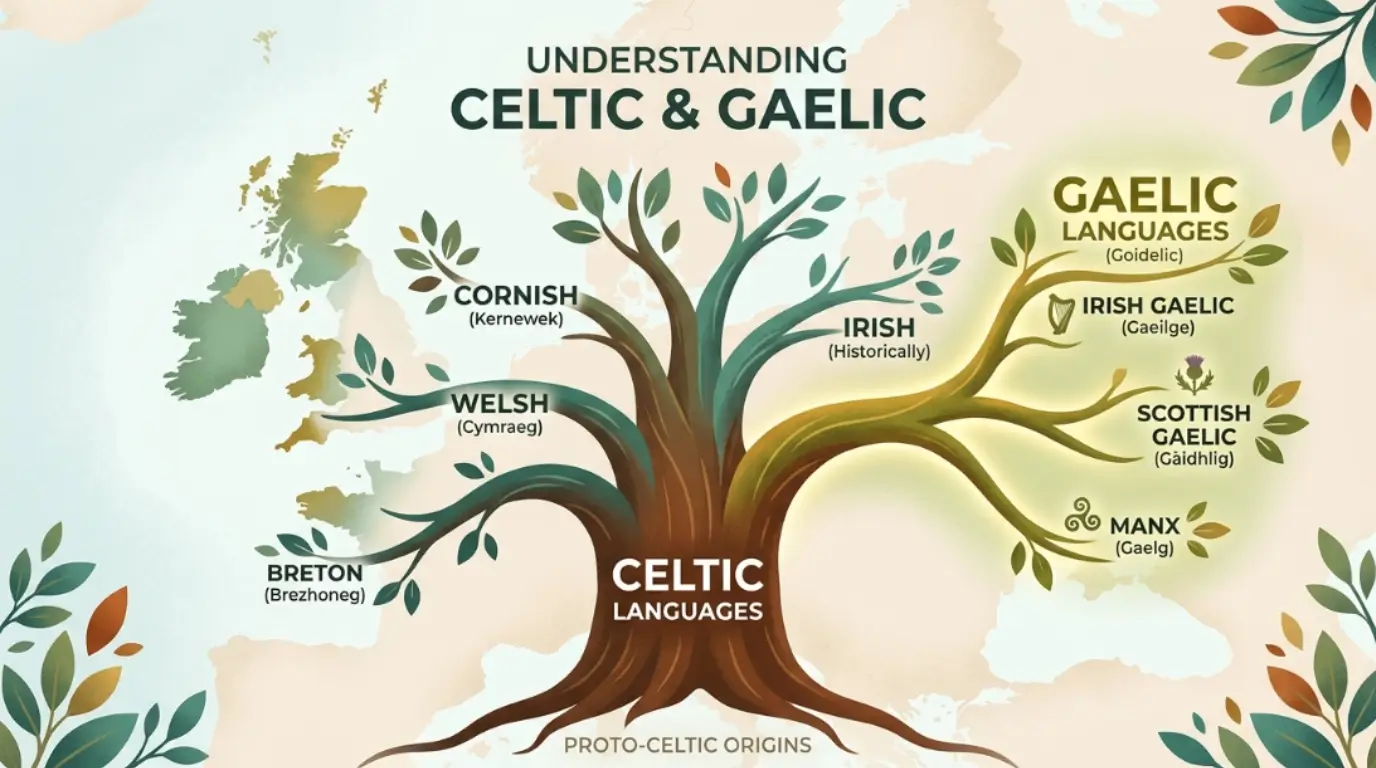
Think of it like a family tree. Celtic is the whole family, and Gaelic is just one branch of that family. Understanding the difference between Celtic and Gaelic helps you avoid mistakes when talking about language, culture, and history.
Many people mix these terms in daily conversation, but knowing the difference between Celtic and Gaelic gives clarity and confidence.
So, what exactly separates them? Let’s break it down step by step.
Key Difference Between Celtic and Gaelic
The main difference is simple:
- Celtic refers to a wide group of people, cultures, and languages.
- Gaelic is a specific language group within the Celtic category.
Why Understanding Their Difference Matters
Knowing the difference between Celtic and Gaelic is important for students, historians, and language learners. It helps in understanding European history, cultural identity, and linguistic roots.
For example, calling all Celtic languages “Gaelic” is incorrect. This can lead to confusion in academic writing or cultural discussions. Experts rely on this distinction to study ancient societies and modern traditions accurately.
Pronunciation (US & UK)
- Celtic
- US: /ˈsɛltɪk/ or /ˈkɛltɪk/
- UK: /ˈkɛltɪk/
- Gaelic
- US: /ˈɡeɪlɪk/
- UK: /ˈɡælɪk/ or /ˈɡeɪlɪk/
Now that you know how to say them, let’s explore their deeper differences.
Difference Between Celtic and Gaelic (10 Key Points)
1. Meaning
Celtic is a broad cultural term. Gaelic is a specific language group.
- Example 1: Celtic traditions include Irish and Welsh customs.
- Example 2: Gaelic includes Irish Gaelic and Scottish Gaelic.
2. Scope
Celtic covers many languages. Gaelic covers only a few.
- Example 1: Celtic includes Welsh, Breton, and Cornish.
- Example 2: Gaelic includes Irish, Scottish, and Manx.
3. Origin
Celtic originated in ancient Europe. Gaelic developed later.
- Example 1: Celtic tribes lived across Europe.
- Example 2: Gaelic evolved mainly in Ireland and Scotland.
4. Usage
Celtic is used culturally. Gaelic is used linguistically.
- Example 1: Celtic festivals celebrate heritage.
- Example 2: Gaelic is spoken in daily communication.
5. Type
Celtic is a category. Gaelic is a subset.
- Example 1: Celtic = family
- Example 2: Gaelic = branch
6. Geography
Celtic regions are wider. Gaelic regions are limited.
- Example 1: Celtic areas include France and Wales.
- Example 2: Gaelic is mainly in Ireland and Scotland.
7. Language Family
Celtic is a language family. Gaelic is part of it.
- Example 1: Celtic includes Brythonic languages.
- Example 2: Gaelic is part of Goidelic languages.
8. Cultural Identity
Celtic identity is broader. Gaelic identity is specific.
- Example 1: A Welsh person is Celtic.
- Example 2: An Irish speaker may be Gaelic.
9. Modern Use
Celtic is often symbolic. Gaelic is still spoken.
- Example 1: Celtic symbols appear in art.
- Example 2: Gaelic is taught in schools.
10. Confusion
People use them interchangeably.
- Example 1: Calling Welsh “Gaelic” is wrong.
- Example 2: Calling all Celtic people “Gaelic” is incorrect.
Nature and Behaviour
Celtic is diverse and wide-ranging. It includes many cultures and traditions. Gaelic is more focused and specific, mainly tied to language and identity.
Why People Are Confused
The confusion comes from overlap. Gaelic is part of Celtic, so people assume they are the same. Also, media and casual speech often mix the terms incorrectly.
Table: Difference and Similarity
| Feature | Celtic | Gaelic | Similarity |
| Type | Broad group | Specific subset | Both cultural terms |
| Language | Many languages | Few languages | Both linguistic roots |
| Region | Wider Europe | Ireland & Scotland | European origin |
| Usage | Cultural | Linguistic | Used in identity |
| Scope | Large | Limited | Historically connected |
Which is Better in What Situation?
Use Celtic when talking about a wide cultural or historical context. It fits discussions about traditions, art, and ancient tribes.
Use Gaelic when referring to language or specific cultural identity in Ireland or Scotland. It is more precise and accurate in linguistic contexts.
Metaphors and Similes
- Celtic as a “tree of cultures”
- Gaelic as a “branch of that tree”
Connotations:
- Celtic: Positive (heritage, unity)
- Gaelic: Neutral to positive (language, identity)
Idioms or Proverbs
There are no direct idioms, but examples include:
- “He carries a Celtic spirit” (heritage pride)
- “She speaks with Gaelic roots” (linguistic identity)
Works in Literature
- Celtic Twilight – Genre: Folklore, Writer: W.B. Yeats, Year: 1893
- A Grammar of Irish Gaelic – Genre: Linguistics, Writer: Various, Year: 20th century
Movies Related to Celtic and Gaelic
- Braveheart (1995, USA)
- The Secret of Kells (2009, Ireland)
- Song of the Sea (2014, Ireland)
FAQs
1. Are Celtic and Gaelic the same?
No, Gaelic is part of the Celtic group.
2. Is Irish a Celtic language?
Yes, and it is also Gaelic.
3. Can Celtic refer to people?
Yes, it refers to a cultural group.
4. Where is Gaelic spoken?
Mainly in Ireland and Scotland.
5. Why is the difference important?
It ensures correct cultural and linguistic understanding.
How Both Are Useful for Society
Celtic preserves broad cultural traditions. Gaelic keeps language alive. Both help maintain identity, history, and diversity in society.
Conclusion
The difference between Celtic and Gaelic becomes clear once you understand their scope. Celtic is the wider umbrella that includes many cultures and languages, while Gaelic is a specific branch within that system.
Knowing this difference helps in accurate communication, better learning, and deeper cultural appreciation.
Whether you are a student, writer, or history lover, understanding these terms adds clarity to your knowledge. In simple words, Celtic is the whole picture, and Gaelic is just one important part of it.