The difference between production and manufacturing is a topic that often confuses students, business owners, and even industry professionals.
Imagine a farmer growing wheat in a field and a factory turning that wheat into packaged flour. Both activities create value, but they are not exactly the same.
This simple example helps explain the difference between production and manufacturing in real life.
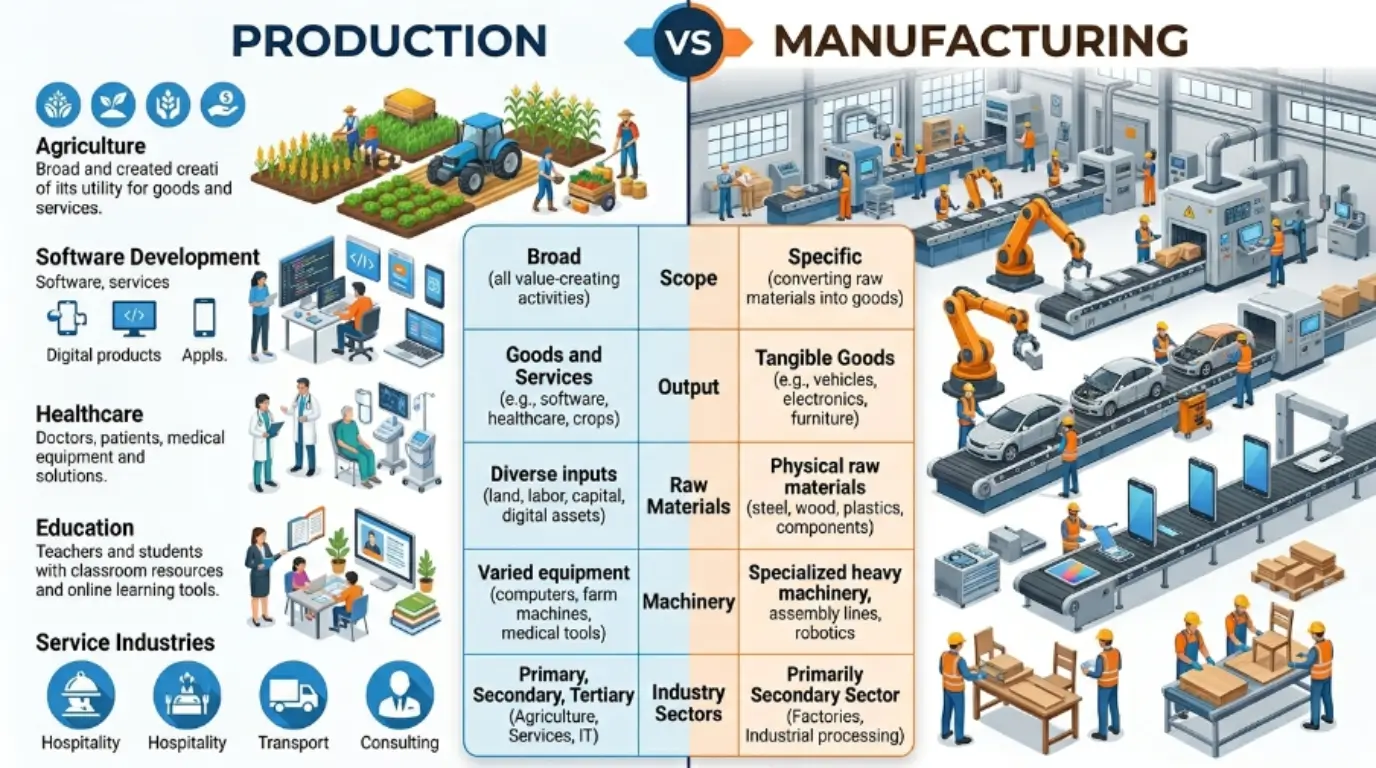
Production is a broader concept that includes creating goods and services, while manufacturing specifically refers to transforming raw materials into finished products.
Understanding the difference between production and manufacturing helps people communicate accurately in business, economics, and industrial operations.
Whether you are a learner, entrepreneur, or expert, knowing the difference between production and manufacturing can improve your understanding of how industries operate and contribute to society.
Key Difference Between Production and Manufacturing
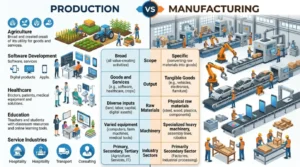
The main difference is that production includes the creation of both goods and services, whereas manufacturing focuses only on converting raw materials into physical products through machinery, tools, and labor.
Why Is Their Difference Necessary to Know?
Understanding these terms helps learners grasp economic concepts and enables professionals to use the correct terminology in business discussions.
Production and manufacturing influence employment, innovation, trade, and economic growth. Knowing their distinction improves decision-making in industries, education, and management.
Pronunciation
| Word | US Pronunciation | UK Pronunciation |
| Production | /prəˈdʌkʃən/ | /prəˈdʌkʃən/ |
| Manufacturing | /ˌmæn.jəˈfæk.tʃər.ɪŋ/ | /ˌmæn.jʊˈfæk.tʃər.ɪŋ/ |
Before exploring the details, let’s look at how these two concepts differ in practical situations.
Difference Between Production and Manufacturing
1. Scope
Production: Covers goods and services.
Examples:
- Teaching students.
- Producing electricity.
Manufacturing: Covers only physical goods.
Examples:
- Making cars.
- Producing furniture.
2. Output Type
Production: Can create tangible or intangible outputs.
Examples:
- Banking services.
- Software development.
Manufacturing: Produces only tangible products.
Examples:
- Mobile phones.
- Shoes.
3. Raw Materials
Production: May or may not require raw materials.
Examples:
- Online consulting.
- Transportation services.
Manufacturing: Always requires raw materials.
Examples:
- Steel for vehicles.
- Cotton for clothing.
4. Process Involved
Production: Includes all activities that create value.
Examples:
- Teaching.
- Farming.
Manufacturing: Focuses on transforming materials.
Examples:
- Wood into tables.
- Plastic into bottles.
5. Use of Machinery
Production: Machinery may not be necessary.
Examples:
- Legal advice.
- Writing content.
Manufacturing: Usually relies heavily on machinery.
Examples:
- Automobile assembly lines.
- Textile machines.
6. Industry Coverage
Production: Includes primary, secondary, and tertiary sectors.
Examples:
- Agriculture.
- Healthcare.
Manufacturing: Primarily belongs to the secondary sector.
Examples:
- Electronics factories.
- Food processing plants.
7. Value Creation
Production: Creates utility and value.
Examples:
- Medical treatment.
- Education services.
Manufacturing: Creates value through physical transformation.
Examples:
- Raw steel into tools.
- Timber into cabinets.
8. Labor Requirement
Production: Can involve physical or intellectual labor.
Examples:
- Teachers.
- Engineers.
Manufacturing: Often involves technical and industrial labor.
Examples:
- Machine operators.
- Assembly workers.
9. Final Result
Production: May result in goods or services.
Examples:
- Insurance services.
- Agricultural products.
Manufacturing: Results in finished products.
Examples:
- Computers.
- Refrigerators.
10. Economic Classification
Production: A broad economic activity.
Examples:
- Farming.
- Retail services.
Manufacturing: A subset of production.
Examples:
- Vehicle production.
- Chemical processing.
Nature and Behavior of Production
Production is broad, flexible, and value-oriented. It focuses on creating utility through goods or services. Its behavior changes depending on customer needs, technology, and market demand.
Nature and Behavior of Manufacturing
Manufacturing is specialized and product-focused. It emphasizes efficiency, standardization, and transformation of raw materials into finished goods. Its behavior depends heavily on machinery, technology, and production systems.
Why People Are Confused About Their Use?
People often use these terms interchangeably because manufacturing is part of production. Since factories are highly visible in the economy, many assume all production activities are manufacturing activities. However, services such as education, healthcare, and banking are examples of production but not manufacturing.
Difference and Similarity Table
| Feature | Production | Manufacturing |
| Definition | Creation of goods and services | Conversion of raw materials into products |
| Scope | Broad | Narrow |
| Output | Goods and services | Physical goods only |
| Raw Materials | Optional | Required |
| Machinery | Not always required | Usually required |
| Sector | All sectors | Secondary sector |
| Value Creation | Direct and indirect | Direct through transformation |
| Labor Type | Physical and intellectual | Mainly technical and industrial |
| Relationship | Parent concept | Subset of production |
| Goal | Create utility | Create finished products |
Similarities
| Similarity |
| Both create value |
| Both support economic growth |
| Both generate employment |
| Both satisfy consumer needs |
| Both require resources and planning |
Which Is Better in What Situation?
Production is better when discussing the overall creation of value in an economy. It applies to industries such as healthcare, education, agriculture, and services.
Economists and policymakers often use the term production because it covers a wide range of activities.
Manufacturing is better when discussing factories, industrial processes, and product creation.
Engineers, plant managers, and industrial experts prefer this term because it specifically refers to converting materials into finished goods. The better term depends on the context and purpose of the discussion.
How the Keywords Are Used in Metaphors and Similes
Production
Metaphor:
- The university is a production machine of future leaders.
Simile:
- Her creativity flowed like a production line of ideas.
Manufacturing
Metaphor:
- The company manufactured success through innovation.
Simile:
- His strategy worked like a manufacturing plant, turning ideas into results.
Connotative Meaning
Production
Positive
- Creativity
- Growth
- Progress
Example:
- The team’s production of new ideas impressed everyone.
Neutral
- Output
- Activity
Example:
- Daily production increased this month.
Manufacturing
Positive
- Efficiency
- Innovation
- Industrial development
Example:
- Manufacturing boosted the local economy.
Negative
- Mass production concerns
- Environmental impact
Example:
- Excessive manufacturing increased pollution.
Idioms and Proverbs Related to the Words
Production
- Strike while the iron is hot
- Make hay while the sun shines
Examples:
- The company expanded production and decided to strike while the iron is hot.
- Farmers increase production because they know to make hay while the sun shines.
Manufacturing
- Built from the ground up
- The wheels of industry never stop
Examples:
- The factory was built from the ground up.
- Modern manufacturing proves that the wheels of industry never stop.
Works in Literature
Production
- Production and Operations Analysis — Steven Nahmias (Business, 2009)
- The Production of Space — Henri Lefebvre (Philosophy, 1974)
- Production Economics — Eugene Silberberg (Economics, 1990)
Manufacturing
- The Wealth of Nations — Adam Smith (Economics, 1776)
- Manufacturing Consent — Edward S. Herman & Noam Chomsky (Political Science, 1988)
- American Manufacturing — David M. Gordon (Economics, 1988)
Movies Related to Production and Manufacturing
Production
- The Founder (2016, USA)
- Joy (2015, USA)
- Flash of Genius (2008, USA)
Manufacturing
- American Factory (2019, USA)
- Made in Dagenham (2010, UK)
- Gung Ho (1986, USA)
Frequently Asked Questions
What is the main difference between production and manufacturing?
Production includes goods and services, while manufacturing focuses only on making physical products.
Is manufacturing a part of production?
Yes, manufacturing is a subset of production.
Can services be considered production?
Yes, services such as healthcare and education are forms of production.
Does manufacturing always require raw materials?
Yes, manufacturing involves transforming raw materials into finished goods.
Which term is broader?
Production is broader because it covers all value-creating activities.
How Both Are Useful for Surroundings
Production and manufacturing improve living standards by creating goods, services, jobs, and economic opportunities.
Production ensures society receives essential services such as education and healthcare, while manufacturing provides products people use daily.
Together, they support innovation, economic development, and community growth.
Conclusion
The difference between production and manufacturing lies mainly in their scope and application.
Production is a broad term that includes creating both goods and services, while manufacturing specifically refers to converting raw materials into finished physical products.
Although closely related, they serve different purposes in economics and industry.
Understanding these concepts helps students, professionals, and business leaders communicate more accurately and make better decisions.
Production and manufacturing work together to support economic growth, create employment opportunities, and improve quality of life.
By recognizing their unique roles, we gain a clearer picture of how modern economies function and prosper.