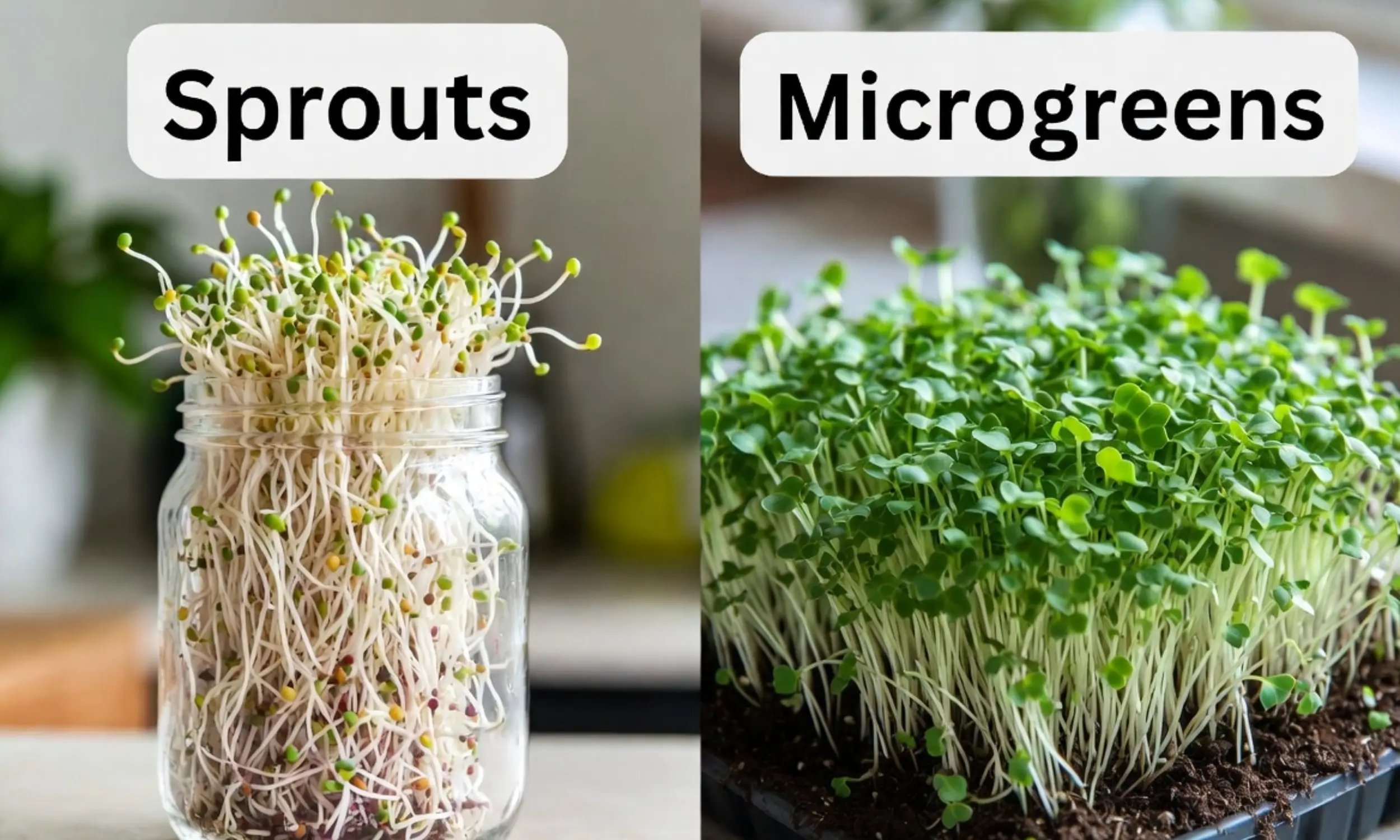
Imagine a busy professional named Sarah who decides to kickstart a “health revolution” in her tiny apartment. She buys a bag of mung beans, soaks them in a jar, and watches them pop with life in just two days. She proudly tells her friends she’s growing microgreens.
A week later, she visits a local farmers’ market and sees beautiful, leafy trays of kale and radish being harvested with scissors. The farmer smiles and says, “Lovely microgreens, aren’t they?” Sarah is baffled.
She realized then that the difference between sprouts and microgreens isn’t just a matter of semantics—it’s a matter of biology.
While both are nutritional powerhouses, the difference between sprouts and microgreens comes down to how they are grown and which parts you actually eat.
Understanding the difference between sprouts and microgreens saved Sarah from a soggy salad and helped her master the art of indoor gardening.
Why the Difference is Necessary for Learners and Experts
In a society increasingly focused on food security and functional nutrition, knowing the difference between sprouts and microgreens is vital.
For the home cook, it’s about food safety and texture. For the nutritionist, it’s about specific vitamin concentrations.
In our fast-paced world, these “living foods” represent a bridge between urban living and agricultural wellness.
Distinguishing between them ensures we use the right culinary techniques and respect the distinct biological journeys of these plants.
Pronunciation Guide
- Sprouts
- US: /spraʊts/
- UK: /spraʊts/
- Microgreens
- US: /ˈmaɪ.kroʊˌɡriːnz/
- UK: /ˈmaɪ.krəʊˌɡriːnz/
Curious about how these tiny greens stack up against each other? Let’s dive into the core characteristics that set them apart.
The Core Difference Between Sprouts and Microgreens
To truly grasp the difference between sprouts and microgreens, we need to look at ten specific areas of growth and consumption.
1. Growing Medium
Sprouts are grown in water, while microgreens are grown in soil or a sterile substrate.
- Example 1: You can grow alfalfa sprouts in a simple glass jar with a mesh lid.
- Example 2: You grow arugula microgreens in a shallow tray filled with potting mix.
2. Harvest Time
Sprouts are ready in 2–5 days. Microgreens take 7–21 days.
- Example 1: Mung bean sprouts are often ready for a stir-fry in just 48 hours.
- Example 2: Beet microgreens may need a full three weeks to develop their vibrant red leaves.
3. Parts Consumed
You eat the whole sprout (seed, root, and stem). For microgreens, you only eat the stem and leaves.
- Example 1: When you eat a lentil sprout, you are eating the original seed casing.
- Example 2: When you eat pea microgreens, you snip them above the soil line and leave the roots behind.
4. Light Requirements
Sprouts grow in the dark. Microgreens need high-quality light to photosynthesize.
- Example 1: Broccoli sprouts stay white or pale yellow because they are kept in a dark cupboard.
- Example 2: Sunflower microgreens turn deep green because they sit on a sunny windowsill.
5. Nutrition Concentration
Sprouts are rich in enzymes and fiber. Microgreens have higher concentrations of Vitamin C, E, and K.
- Example 1: Wheat sprouts are excellent for aiding digestion due to high enzyme activity.
- Example 2: Red cabbage microgreens have 40 times more Vitamin E than the mature vegetable.
6. Food Safety Risk
Sprouts have a higher risk of bacterial growth due to the warm, humid environment. Microgreens are generally safer.
- Example 1: Commercial sprouts are frequently tested for E. coli and Salmonella.
- Example 2: Microgreens grow in open air, which reduces the chance of mold and pathogens.
7. Flavor Profile
Sprouts are usually crunchy and mild. Microgreens have intense, concentrated flavors.
- Example 1: Bean sprouts add a refreshing “watery” crunch to Pad Thai.
- Example 2: Radish microgreens provide a powerful, spicy kick that mimics a full-sized radish.
8. Seed Density
Sprouts are grown in very tight clusters. Microgreens need a bit more space to breathe and expand.
- Example 1: A single jar can hold hundreds of clover sprouts packed tightly together.
- Example 2: Cilantro microgreens need space so their “true leaves” don’t overlap and rot.
9. Complexity of Growth
Sprouts require frequent rinsing. Microgreens require consistent watering and light management.
- Example 1: You must rinse sprouts every 8 hours to keep them clean.
- Example 2: You only need to mist or bottom-water microgreens once a day.
10. Post-Harvest Life
Sprouts must be eaten quickly as they spoil fast. Microgreens can sometimes be sold “live” in their trays.
- Example 1: Store-bought sprouts often get slimy within 3 days.
- Example 2: You can keep a tray of basil microgreens on your counter and harvest as needed for a week.
Nature and Behavior
Sprouts are essentially “seeds on the go.” Their behavior is explosive and rapid, fueled entirely by the energy stored within the seed itself. They are the “infants” of the plant world.
Microgreens are “toddler plants.” They have begun to feed on sunlight and soil nutrients. Their behavior is more structured, resulting in a complex leaf structure and a more robust physical form.
Why the Confusion?
People are confused because both are marketed as “baby plants” and found in the same health-food aisle. Since they both look like small green shoots, many assume they are the same thing at different stages. Furthermore, the same seed (like a radish seed) can be grown as either a sprout or a microgreen, making the distinction even blurrier.
Comparison Table
| Feature | Sprouts | Microgreens |
| Medium | Water | Soil/Substrate |
| Light | Dark/Low Light | High Light |
| Edible Parts | Seed, Root, Stem | Stem, Leaves |
| Taste | Mild/Crunchy | Intense/Bold |
| Safety | Lower (Higher Bacteria Risk) | Higher (Air Circulation) |
| Time to Harvest | 2–5 Days | 1–3 Weeks |
Which is Better in What Situation?
Sprouts are the winner when you need immediate volume and texture. If you are looking to bulk up a stir-fry, a sandwich, or a budget-friendly salad, sprouts are the way to go. They are incredibly cheap to produce and require zero specialized equipment like grow lights or soil.
Microgreens are superior for gourmet cooking and targeted nutrition. If you want to garnish a steak with a burst of peppery flavor or maximize your antioxidant intake in a small serving, microgreens are the choice. They are the preferred option for those with compromised immune systems who want to avoid the bacterial risks associated with raw sprouts.
Figurative Language and Connotations
Metaphors and Similes
- Metaphor: “The company was a mere sprout, small but bursting with the potential of a giant oak.”
- Simile: “The chef’s garden was like a carpet of microgreens, vibrant, fragile, and packed with hidden power.”
Connotative Meanings
- Sprouts (Positive/Neutral): Suggests growth, new beginnings, and vitality. Example: “The sprouts of a new friendship.”
- Microgreens (Positive/Luxury): Suggests refinement, health-conscious living, and culinary excellence. Example: “The dish was elevated by a delicate crown of microgreens.”
Idioms and Proverbs
- “To sprout wings” (To suddenly become successful or take flight).
- Example: After the funding, the small startup really sprouted wings.
- “Small seeds grow big trees” (Related to the potential of sprouts).
- Example: Don’t ignore the sprouts of your labor; remember, small seeds grow big trees.
Literature and Film
Works in Literature:
- The Secret of the Sprout (Non-fiction/Health, Steve Meyerowitz, 1999)
- Microgreens: A Guide to Growing Nutrient-Packed Greens (Gardening, Eric Franks, 2009)
Movies:
- The Sprout (Short Film/Drama, 2014, South Korea)
- Microcosmos (Documentary, 1996, France – while about insects, it famously features the “micro-world” of greens).
Frequently Asked Questions (FAQs)
Can I grow microgreens in a jar?
No, they need soil and airflow to prevent root rot.
Are sprouts safe for pregnant women?
Generally, doctors recommend cooking sprouts first to kill potential bacteria.
Do I need fertilizer for microgreens?
Usually no, as the seed provides enough energy for the first two leaves.
Can any vegetable seed be a sprout?
Most can, but avoid nightshades (tomato, pepper) as their sprouts are toxic.
Which is more expensive?
Microgreens are typically more expensive due to the labor and resources involved.
Usefulness for Surroundings
Both help the environment by promoting urban agriculture. They require significantly less water than mature crops and zero pesticides. Growing them at home reduces “food miles,” lowering your carbon footprint while purifying your indoor air.
Conclusion
Understanding the difference between sprouts and microgreens is more than a culinary trivia point; it is a gateway to intentional eating.
While sprouts provide quick, easy-access nutrition and fiber, microgreens offer a gourmet experience with a specialized vitamin profile.
By recognizing how they differ in growth, safety, and flavor, you can better tailor your diet to your health needs and your palate.
Whether you are a beginner or an expert, embracing these tiny titans will undoubtedly enrich your meals.