Imagine a young father who buys a life policy to protect his family after his death, while his neighbor purchases a car policy to recover losses after an accident.
Both believe they are financially secure, but the type of protection they choose is different. This is where the difference between insurance and assurance becomes important.
Many people use these terms interchangeably because both deal with financial protection. However, the difference between insurance and assurance lies in the type of risk, certainty of payment, and purpose of coverage.
Understanding the difference between insurance and assurance helps people make smarter financial decisions.
Whether you are a student, investor, or policyholder, knowing the difference between insurance and assurance can prevent confusion and improve your understanding of financial planning in everyday life.
Key Difference Between the Both
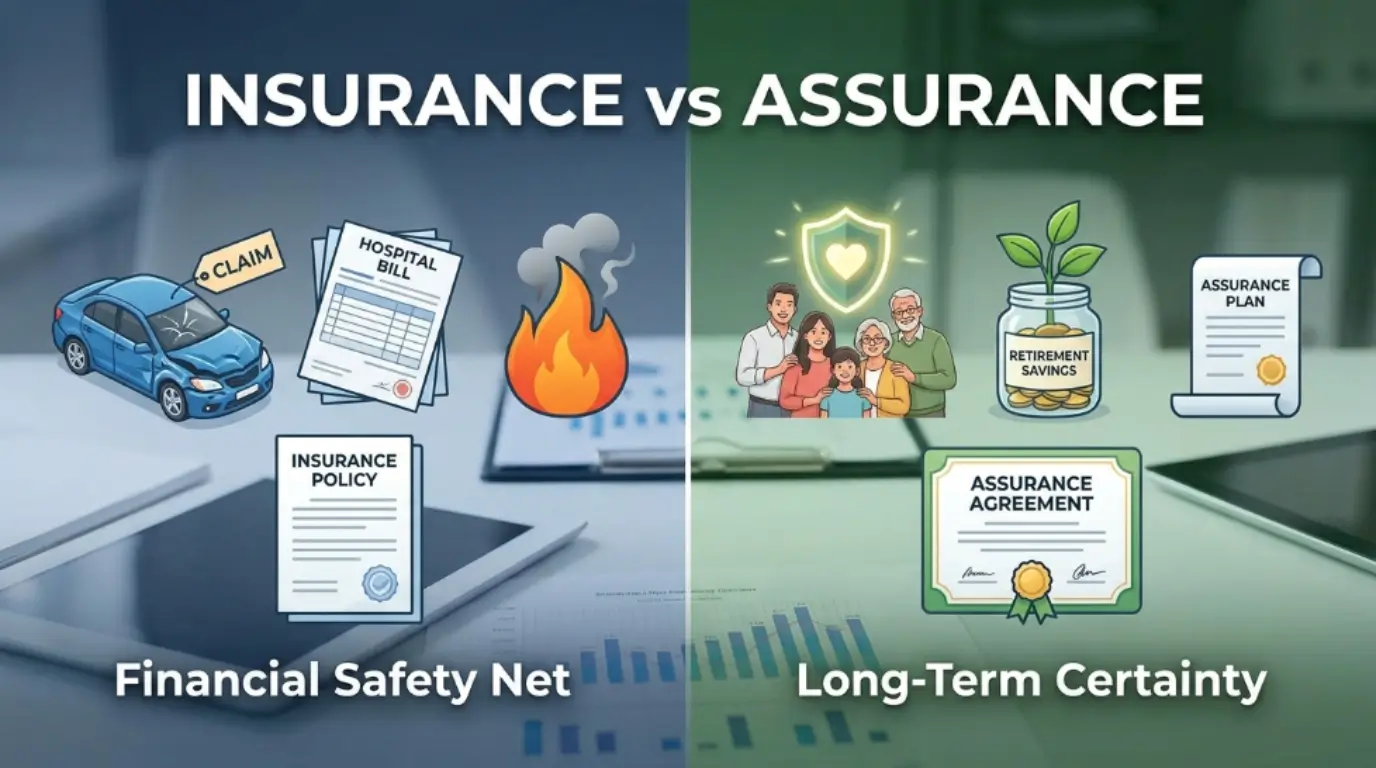
Insurance protects against uncertain events such as accidents, fire, theft, or illness. Assurance provides coverage for events that are certain to happen, mainly death. Insurance focuses on risk protection, while assurance focuses on long-term financial certainty.
Why Is Their Difference Necessary to Know?
Knowing the distinction between insurance and assurance is important for learners, professionals, and society. It helps people choose the right financial product according to their needs. Businesses use insurance to reduce risks, while families use assurance for future financial stability. Experts in banking, law, and finance also rely on this knowledge to guide clients properly. In society, these services create confidence and economic security during difficult situations.
Pronunciation
| Word | US Pronunciation | UK Pronunciation |
| Insurance | in-SHOOR-uhns | in-SHYOO-ruhns |
| Assurance | uh-SHOOR-uhns | uh-SHYOO-ruhns |
Both words sound similar, which is one reason people confuse them. To understand their true meaning, let us explore their differences in detail.
Difference Between Insurance and Assurance
1. Meaning
Insurance:
Insurance provides financial protection against uncertain events.
Examples:
- Car insurance covers accident damage.
- Health insurance pays medical expenses.
Assurance:
Assurance guarantees payment for an event that will definitely happen.
Examples:
- Life assurance pays after death.
- Endowment assurance gives payment after a fixed period.
2. Nature of Risk
Insurance:
Insurance deals with uncertain risks.
Examples:
- House fire may or may not occur.
- Theft might never happen.
Assurance:
Assurance deals with certain events.
Examples:
- Death is unavoidable.
- Maturity of a policy is guaranteed.
3. Duration
Insurance:
Usually short-term and renewed yearly.
Examples:
- Annual travel insurance.
- One-year bike insurance.
Assurance:
Mostly long-term contracts.
Examples:
- Whole life assurance policy.
- 20-year assurance plan.
4. Purpose
Insurance:
Its purpose is compensation for loss.
Examples:
- Compensation after flood damage.
- Payment after vehicle theft.
Assurance:
Its purpose is financial security.
Examples:
- Family support after death.
- Savings for future needs.
5. Payment of Claim
Insurance:
Claim is paid only if the event happens.
Examples:
- No accident means no payment.
- No theft means no claim.
Assurance:
Payment is guaranteed.
Examples:
- Death benefit always paid.
- Policy maturity amount always given.
6. Premium Amount
Insurance:
Premium may change depending on risk.
Examples:
- Smokers pay higher health premiums.
- Sports cars have expensive insurance.
Assurance:
Premium is usually fixed.
Examples:
- Fixed yearly life assurance payment.
- Stable premiums for long-term policies.
7. Compensation Basis
Insurance:
Compensation equals the actual loss.
Examples:
- Repair cost for damaged car.
- Medical bill reimbursement.
Assurance:
Full assured amount is paid.
Examples:
- Full life policy amount to family.
- Guaranteed maturity benefit.
8. Policy Type
Insurance:
Covers property, health, or business risks.
Examples:
- Fire insurance.
- Marine insurance.
Assurance:
Mostly linked with life policies.
Examples:
- Whole life assurance.
- Pension assurance.
9. Investment Element
Insurance:
Usually focuses only on protection.
Examples:
- Car insurance has no savings value.
- Travel insurance is temporary.
Assurance:
Often includes savings or investment benefits.
Examples:
- Endowment plans build savings.
- Retirement assurance grows funds.
10. Certainty of Event
Insurance:
The event may never occur.
Examples:
- Some people never claim health insurance.
- Businesses may avoid fire damage forever.
Assurance:
The event will certainly occur.
Examples:
- Every life ends eventually.
- Maturity date always arrives.
Nature and Behaviour of Both
Insurance behaves like a protective shield against sudden danger. It is reactive because it responds after a loss occurs. People buy insurance mainly to reduce financial uncertainty.
Assurance behaves like a long-term promise. It is proactive because it guarantees future financial support. People buy assurance to secure their family’s future and savings goals.
Why Are People Confused About Their Use?
People often confuse these terms because both provide financial protection and are sold by similar companies. Their pronunciation is also very close. In some countries, the words are even used interchangeably in advertisements and daily conversation. Another reason is that life insurance is commonly called “life assurance” in some regions.
Difference and Similarity Table
| Aspect | Insurance | Assurance | Similarity |
| Risk Type | Uncertain | Certain | Both provide protection |
| Duration | Short-term | Long-term | Both require premiums |
| Claim Payment | Conditional | Guaranteed | Both involve contracts |
| Main Purpose | Compensation | Financial security | Both reduce stress |
| Coverage | Property and health | Mostly life | Both support families |
| Investment Feature | Rare | Common | Both involve money planning |
Which Is Better in What Situation?
Insurance is better when people want protection against unexpected losses. For example, health insurance is useful for medical emergencies, while vehicle insurance helps after accidents. Businesses also depend on insurance to avoid major financial losses.
Assurance is better for long-term financial planning. Families use life assurance to protect dependents after death. It is also useful for retirement planning, children’s education funds, and future savings goals.
How the Keywords Are Used in Metaphors and Similes
Insurance in Metaphors and Similes
- “Insurance is a safety net for life’s surprises.”
- “His insurance worked like an umbrella in a storm.”
Assurance in Metaphors and Similes
- “Her words were an assurance of hope.”
- “Assurance stood like a lighthouse in difficult times.”
Connotative Meaning
| Word | Connotation | Example |
| Insurance | Neutral to Positive | “Insurance brings peace during emergencies.” |
| Assurance | Positive | “Her assurance gave confidence to the family.” |
Idioms or Proverbs Related to the Words
- “Better safe than sorry.”
Example: Buying health insurance is better safe than sorry. - “A stitch in time saves nine.”
Example: Life assurance helps families avoid future financial problems.
Works in Literature
Insurance
- The Insurance Man — Drama, Nissim Aloni, 1975
- Double Indemnity — Crime Fiction, James M. Cain, 1943
Assurance
- Sense and Sensibility — Novel, Jane Austen, 1811
- Great Expectations — Novel, Charles Dickens, 1861
Movies Related to the Keywords
Insurance
- Double Indemnity — 1944, USA
- The Rainmaker — 1997, USA
Assurance
- Life as a House — 2001, USA
- Ikiru — 1952, Japan
Frequently Asked Questions
1. What is the main difference between insurance and assurance?
Insurance covers uncertain events, while assurance covers certain events like death.
2. Is life insurance the same as life assurance?
In many places, the terms are used together, but life assurance usually refers to guaranteed long-term coverage.
3. Which is short-term, insurance or assurance?
Insurance is generally short-term, while assurance is long-term.
4. Why do companies offer both services?
Companies provide both to meet different financial protection and savings needs.
5. Can assurance include investment benefits?
Yes, many assurance plans include savings and investment features.
How Both Are Useful for Surroundings
Insurance helps society recover from accidents, disasters, and emergencies. It supports businesses, hospitals, and families during financial crises. Assurance strengthens long-term financial stability and encourages responsible planning. Together, they create economic confidence and reduce stress in communities.
Final Words for the Both Conclusion
The difference between insurance and assurance is simple once their purpose is understood clearly. Insurance protects people against uncertain risks, while assurance guarantees financial support for certain future events.
Both play important roles in financial planning and social stability. Insurance offers immediate protection during emergencies, whereas assurance provides long-term peace of mind for families and individuals.
Although people often confuse these terms because of their similar sound and related services, their functions are different.
Understanding the difference between insurance and assurance allows people to choose better financial solutions according to their needs.
In modern society, both are valuable tools that provide safety, confidence, and financial security for a better future.