A few days ago, a friend bought a car charger and called it an inverter. Later, his phone didn’t charge properly. The shopkeeper smiled and said, “You needed a converter, not an inverter.”
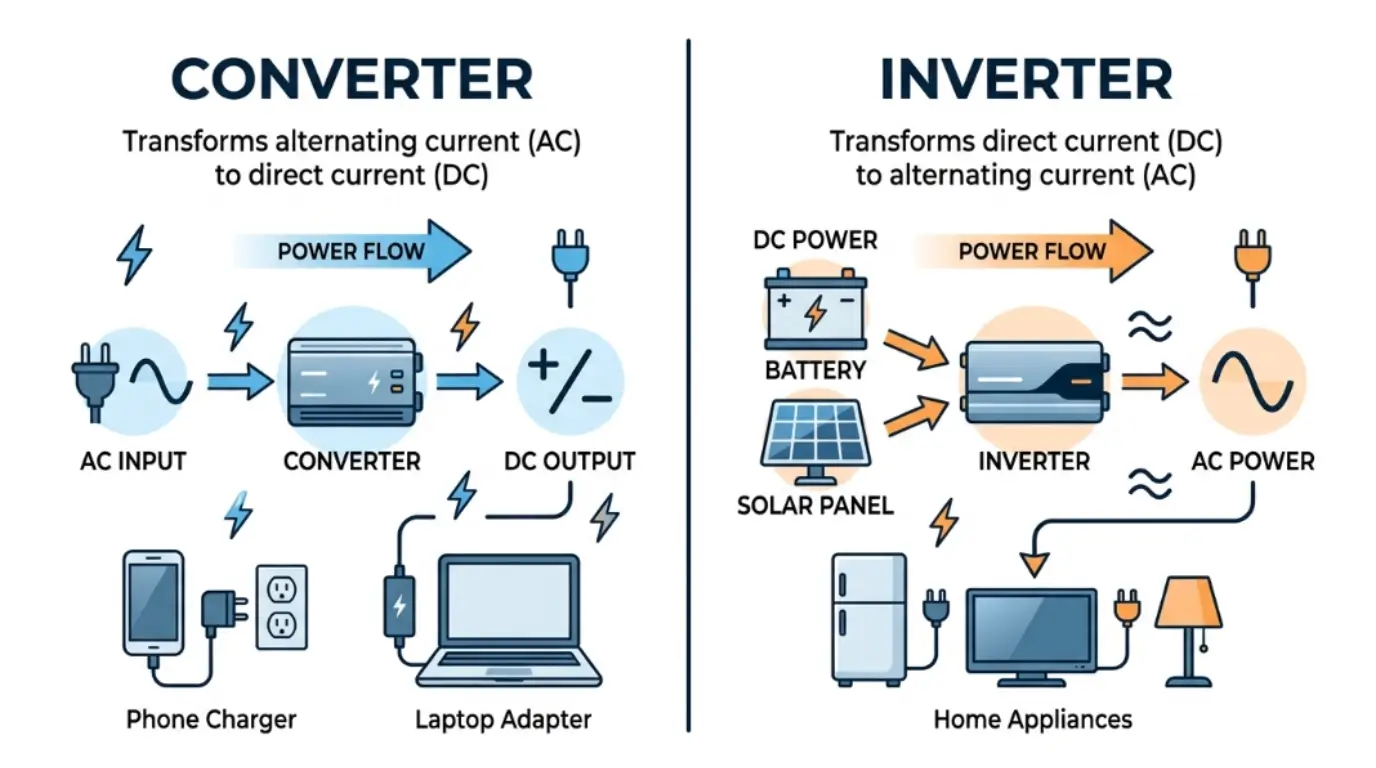
This small confusion shows why the difference between converter and inverter matters in real life. A converter changes one type of electrical signal into another, while an inverter specifically turns DC (direct current) into AC (alternating current).
Understanding the difference between converter and inverter helps you pick the right device for your home, car, or solar system.
Whether you are a beginner or an expert, knowing the difference between converter and inverter saves money, avoids damage, and improves efficiency.
So, let’s break down the difference between converter and inverter in the simplest way.
Key Difference Between Converter and Inverter
A converter changes electrical power from one form to another (AC to DC or DC to DC).
An inverter converts DC power into AC power only.
Why Is This Difference Important?
Knowing the difference between converter and inverter is useful for students, engineers, and everyday users. It helps you choose the right device for appliances, batteries, and solar systems. In society, these devices power homes, charge gadgets, and support industries. Without understanding their roles, people may waste energy or damage equipment. This knowledge builds smarter usage and supports modern energy solutions.
Pronunciation
- Converter (US): /kənˈvɝː.t̬ɚ/ | (UK): /kənˈvɜː.tə/
- Inverter (US): /ɪnˈvɝː.t̬ɚ/ | (UK): /ɪnˈvɜː.tə/
👉 Now that you know the basics, let’s dive deeper into the full difference between converter and inverter.
Difference Between Converter and Inverter
1. Function
Converter changes electrical form; inverter changes DC to AC.
- Example (Converter): Laptop charger converts AC to DC.
- Example (Converter): Phone adapter changes voltage.
- Example (Inverter): Solar inverter powers home appliances.
- Example (Inverter): Car inverter runs a laptop.
2. Direction of Power
Converter works in multiple directions; inverter works one way (DC to AC).
- Converter: AC to DC adapter.
- Converter: DC to DC regulator.
- Inverter: Battery to AC supply.
- Inverter: UPS system output.
3. Usage
Converters are used in electronics; inverters are used in power systems.
- Converter: Mobile charging.
- Converter: LED drivers.
- Inverter: Backup power.
- Inverter: Solar energy systems.
4. Complexity
Converters are simple; inverters are more complex.
- Converter: Small circuits.
- Converter: Low cost devices.
- Inverter: Large systems.
- Inverter: High-tech control.
5. Output Type
Converter output varies; inverter output is always AC.
- Converter: DC output.
- Converter: Regulated voltage.
- Inverter: Pure sine wave.
- Inverter: Modified sine wave.
6. Size
Converters are compact; inverters are larger.
- Converter: Phone charger.
- Converter: USB adapter.
- Inverter: Home backup unit.
- Inverter: Industrial system.
7. Cost
Converters are cheaper; inverters are expensive.
- Converter: Low budget devices.
- Converter: Everyday electronics.
- Inverter: High cost systems.
- Inverter: Solar setups.
8. Efficiency
Converters are highly efficient; inverters vary.
- Converter: Stable conversion.
- Converter: Minimal loss.
- Inverter: Depends on type.
- Inverter: Loss in conversion.
9. Application Area
Converters are for small electronics; inverters for heavy loads.
- Converter: Gadgets.
- Converter: Computers.
- Inverter: Homes.
- Inverter: Factories.
10. Energy Source
Converters depend on input; inverters rely on batteries or solar.
- Converter: Direct supply.
- Converter: Plug-in devices.
- Inverter: Battery backup.
- Inverter: Solar panels.
Nature and Behaviour
Converters are flexible and adapt to different power needs. They are quiet and stable. Inverters are powerful and dynamic. They handle large loads and provide backup power when electricity fails.
Why People Get Confused
People confuse these terms because both deal with electricity conversion. Also, both are used in devices like UPS and chargers. The names sound similar, which adds to the confusion.
Table: Difference and Similarity
| Feature | Converter | Inverter | Similarity |
| Function | Changes electrical form | DC to AC | Both modify power |
| Usage | Electronics | Power systems | Used daily |
| Size | Small | Large | Electrical devices |
| Cost | Low | High | Investment devices |
| Output | Varies | AC only | Provide usable power |
Which Is Better in What Situation?
A converter is better when you need to charge devices or adjust voltage. It is perfect for small electronics and daily use. It is simple and cost-effective.
An inverter is better when you need backup power or want to run appliances during outages. It is ideal for homes, offices, and solar systems. It handles heavy loads efficiently.
Metaphors and Similes
- Converter: “Like a translator changing language.”
- Inverter: “Like a bridge turning one path into another.”
Connotative Meaning
- Converter: Neutral (useful, practical)
- Inverter: Positive (powerful, reliable)
Examples:
- “He is a converter of ideas into action.”
- “She is an inverter of problems into solutions.”
Idioms / Proverbs
- “Turn the tables” (like inverter changing direction)
- “Change gears” (like converter adapting power)
Works in Literature
- The Power Converter Guide (Technical, John Smith, 2015)
- Energy Systems and Inverters (Engineering, Lisa Ray, 2018)
Movies Related to Keywords
- The Converter (2017, USA)
- Inverter Power (2020, India)
FAQs
1. What is the main difference between converter and inverter?
A converter changes electrical form; an inverter converts DC to AC.
2. Can a converter act as an inverter?
No, they have different functions.
3. Where is an inverter used?
In homes, solar systems, and backup power.
4. Why are converters important?
They help charge and power electronic devices.
5. Which is more expensive?
Inverters are usually more costly.
Conclusion
The difference between converter and inverter is simple but very important. A converter changes electrical power in different ways, while an inverter focuses on converting DC to AC. Both play key roles in modern life.
From charging phones to powering homes, they make electricity usable and efficient. Understanding the difference between converter and inverter helps you choose wisely, save money, and use devices safely.
Whether you are a student or a professional, this knowledge is valuable in today’s energy-driven world.