At a music festival, two friends were talking about party drugs. One person said they tried “Ecstasy,” while the other claimed Molly was completely different.
This kind of confusion happens often because many people think these two terms mean the same thing. The truth is more complicated.
The difference between Ecstasy and Molly is important because both terms are connected to the drug MDMA, yet they are sold in different forms and may contain different substances.
Understanding the difference between Ecstasy and Molly can help learners, researchers, parents, and health experts stay informed. In modern society, discussions about party culture, nightlife, and drug safety frequently include these terms.
Knowing the difference between Ecstasy and Molly also helps people avoid misinformation and understand the risks linked with recreational drug use.
Meaning of Ecstasy and Molly
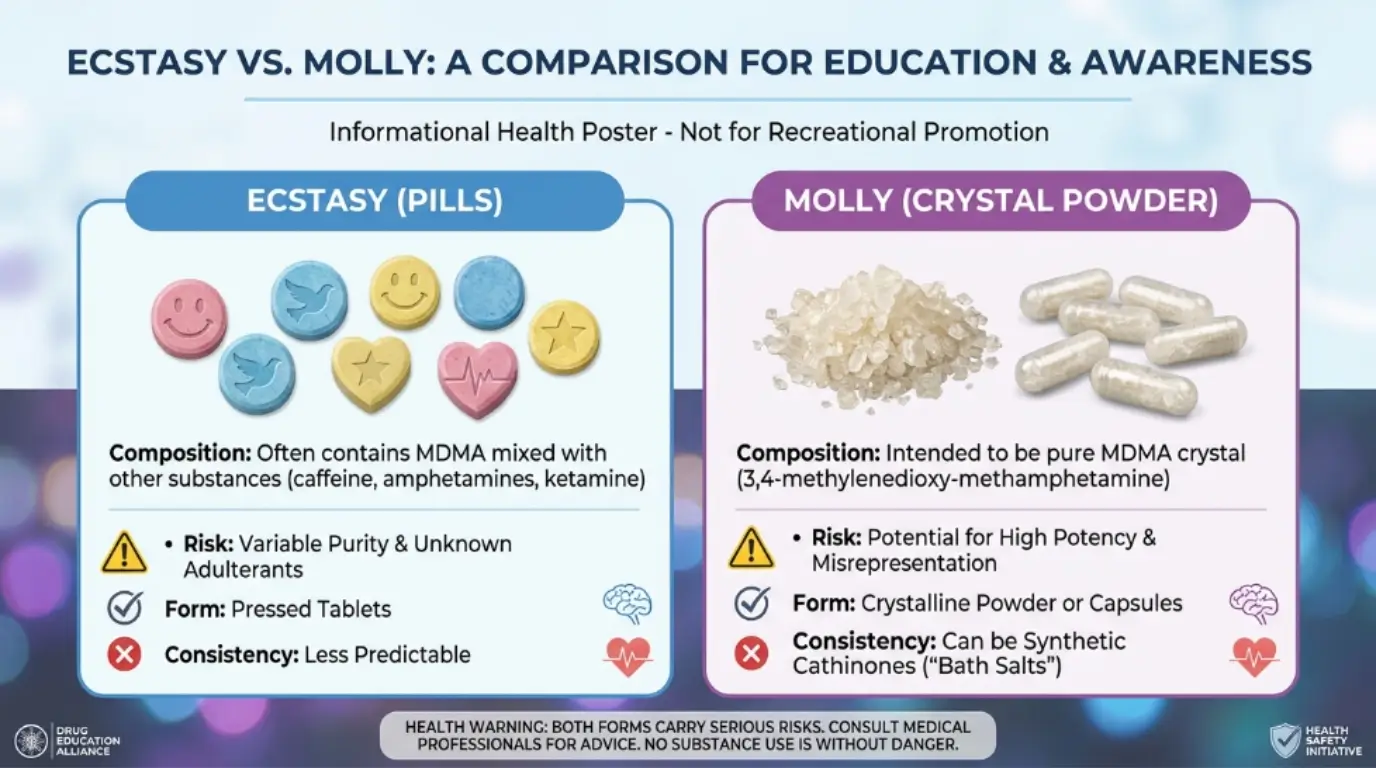
- Ecstasy usually refers to MDMA sold in colorful tablets or pills.
- Molly is commonly described as the powdered or crystal form of MDMA, often sold in capsules.
Pronunciation
Ecstasy
- US: /ˈek.stə.si/
- UK: /ˈek.stə.si/
Molly
- US: /ˈmɑː.li/
- UK: /ˈmɒl.i/
Although these words sound simple, their meanings and usage create many debates. To understand the topic clearly, let us explore the real differences between them.
Why Is Their Difference Important to Know?
The difference matters because both words are connected to health, law, and social awareness. Many people wrongly believe Molly is always safer than Ecstasy. However, illegal drugs may contain dangerous chemicals mixed with MDMA. Experts study these differences to spread awareness about addiction, mental health problems, and safety risks. Learners also need correct information because movies, music, and social media often present confusing ideas about these substances. Society benefits when people understand facts instead of myths.
Difference Between Ecstasy and Molly
1. Form
Ecstasy:
Ecstasy is mostly sold as pills or tablets with logos and colors.
Examples:
- A pink heart-shaped tablet sold at a nightclub.
- A blue pill with a cartoon symbol pressed on it.
Molly:
Molly is usually sold as powder or crystals inside capsules.
Examples:
- White crystal powder in a small plastic bag.
- Powder-filled capsule sold at a concert.
2. Purity
Ecstasy:
Ecstasy pills may contain mixed substances besides MDMA.
Examples:
- Pills mixed with caffeine.
- Tablets containing dangerous synthetic chemicals.
Molly:
Molly is marketed as “pure MDMA,” though it may still be contaminated.
Examples:
- Crystal powder advertised as pure MDMA.
- Capsules later found to contain bath salts.
3. Appearance
Ecstasy:
Often colorful and designed with stamped images.
Examples:
- Green tablet with a smiley logo.
- Red capsule-shaped pill.
Molly:
Usually appears as white or off-white crystals.
Examples:
- Shiny crystal chunks.
- Fine white powder.
4. Street Reputation
Ecstasy:
Ecstasy is often linked with older rave culture.
Examples:
- Popular in 1990s dance clubs.
- Associated with underground parties.
Molly:
Molly became popular in modern festival culture.
Examples:
- Mentioned in rap songs.
- Common at EDM festivals.
5. Packaging
Ecstasy:
Usually packaged in pill bags or strips.
Examples:
- Pills wrapped in foil.
- Small zip-lock bag of tablets.
Molly:
Commonly sold in capsules or loose powder.
Examples:
- Powder in tiny envelopes.
- Clear capsules filled with crystals.
6. Marketing
Ecstasy:
Often sold using colorful branding.
Examples:
- Pills with famous cartoon logos.
- Bright shapes to attract buyers.
Molly:
Promoted as cleaner and more natural.
Examples:
- Sellers claiming “100% pure Molly.”
- Advertisements calling it premium MDMA.
7. Risk Perception
Ecstasy:
People may see Ecstasy as dangerous because of mixed ingredients.
Examples:
- News stories about toxic pills.
- Warnings from health organizations.
Molly:
Some users wrongly believe Molly is safer.
Examples:
- Festival users trusting crystal forms more.
- Social media calling it “clean MDMA.”
8. Cultural Image
Ecstasy:
Linked with rave fashion and club scenes.
Examples:
- Glow sticks and dance parties.
- 1990s electronic music culture.
Molly:
Connected with younger party audiences.
Examples:
- College festivals.
- Modern nightlife culture.
9. Drug Testing Results
Ecstasy:
Testing often shows multiple substances.
Examples:
- Pills containing methamphetamine.
- Tablets mixed with ketamine.
Molly:
Sometimes tests reveal impurities too.
Examples:
- Powder mixed with fentanyl.
- Crystals containing synthetic stimulants.
10. Public Understanding
Ecstasy:
The public often recognizes Ecstasy as a street drug.
Examples:
- Anti-drug campaigns mentioning Ecstasy.
- Movies showing Ecstasy pills.
Molly:
Many people think Molly is different from Ecstasy.
Examples:
- Festival conversations separating the two.
- Music lyrics using “Molly” as a trendy term.
Nature and Behaviour of Both
Ecstasy:
Ecstasy acts as a stimulant and hallucinogenic drug. It may increase energy, emotional warmth, and excitement. However, it can also cause dehydration, anxiety, and dangerous health effects.
Molly:
Molly is expected to behave similarly because it is associated with MDMA. Yet its effects may vary because illegal products are often mixed with unknown substances.
Why Are People Confused About Their Use?
People are confused because both names describe forms of MDMA. Movies, music, and social media use the terms differently. Some believe Molly is pure and safe while Ecstasy is fake and dangerous. In reality, both can be risky because illegal drug markets are unregulated.
Difference and Similarity Table
| Feature | Ecstasy | Molly | Similarity |
| Form | Pills/Tablets | Powder/Crystals | Both linked to MDMA |
| Appearance | Colorful pills | White crystals | Recreational use |
| Reputation | Older rave culture | Modern festival culture | Can affect mood |
| Purity | Often mixed | Marketed as pure | May contain additives |
| Packaging | Tablet bags | Capsules or powder | Illegal in many places |
Which Is Better in What Situation?
From a medical and safety perspective, neither Ecstasy nor Molly is considered safe for recreational misuse. Both may contain dangerous chemicals and can lead to physical or mental harm. Health professionals strongly warn against illegal drug use because products sold on the street are unpredictable.
In discussions about culture, people may use “Ecstasy” when talking about older rave scenes and “Molly” when referring to modern festival culture. However, this difference is mostly social rather than scientific.
Metaphors and Similes
Ecstasy
- “The crowd danced in ecstasy like waves crashing in the ocean.”
- “Her joy was pure ecstasy after winning the match.”
Molly
- “The party lights sparkled around him like a Molly-fueled dream.”
- “The concert felt wild as a storm powered by Molly.”
Connotative Meanings
Ecstasy
- Positive: Extreme happiness or excitement.
- Negative: Dangerous drug culture.
- Neutral: A term used in discussions about MDMA.
Examples:
- “She felt ecstasy after hearing the good news.”
- “The documentary explored Ecstasy use in clubs.”
Molly
- Positive: Seen by some users as cleaner or modern.
- Negative: Linked with risky party behavior.
- Neutral: Slang term connected to MDMA.
Examples:
- “The song mentioned Molly in its lyrics.”
- “Health experts warned about fake Molly.”
Idioms or Related Expressions
While there are no direct idioms for these words, related expressions include:
- “On cloud nine” — feeling intense happiness.
- “Chasing highs” — seeking excitement repeatedly.
- “Party like there’s no tomorrow” — reckless celebration.
Examples:
- “After graduation, he felt on cloud nine.”
- “Some people spend years chasing highs.”
Works in Literature
Ecstasy
- Ecstasy: Three Tales of Chemical Romance — Irvine Welsh — Fiction — 1996
- Beautiful Boy — David Sheff — Memoir — 2008
Molly
- Go Ask Alice — Anonymous — Diary Fiction — 1971
- Tweaked — Katherine Holubitsky — Young Adult Fiction — 2007
Movies Related to the Topic
Ecstasy
- Human Traffic — 1999 — UK
- Groove — 2000 — USA
Molly
- We Are Your Friends — 2015 — USA
- Project X — 2012 — USA
Frequently Asked Questions
1. Are Ecstasy and Molly the same thing?
Both are connected to MDMA, but Ecstasy is usually pills while Molly is powder or crystals.
2. Is Molly safer than Ecstasy?
Not necessarily. Both may contain dangerous mixed substances.
3. Why is Ecstasy colorful?
Dealers often use logos and colors for branding purposes.
4. Why do people use these terms differently?
Music, social media, and party culture shaped different meanings over time.
5. Why should people know the difference?
Understanding the difference helps spread awareness about health and safety risks.
How Both Are Useful for Surroundings
Knowledge about Ecstasy and Molly helps schools, families, and communities create awareness programs. Experts use this information to study drug trends and improve public health education. Clear understanding also helps reduce myths and misinformation in society.
Conclusion
The difference between Ecstasy and Molly mainly comes down to form, marketing, and public perception.
Ecstasy is usually sold as pills, while Molly is commonly sold as powder or crystals. Even though both are linked with MDMA, neither guarantees purity or safety.
This topic matters because many people misunderstand the risks involved. Learners, parents, researchers, and health experts all benefit from accurate information about these substances.
Popular culture often glamorizes these names, but understanding the reality behind them encourages smarter and safer discussions.
By learning the facts, society can reduce confusion and promote better awareness about drug-related risks and public health.