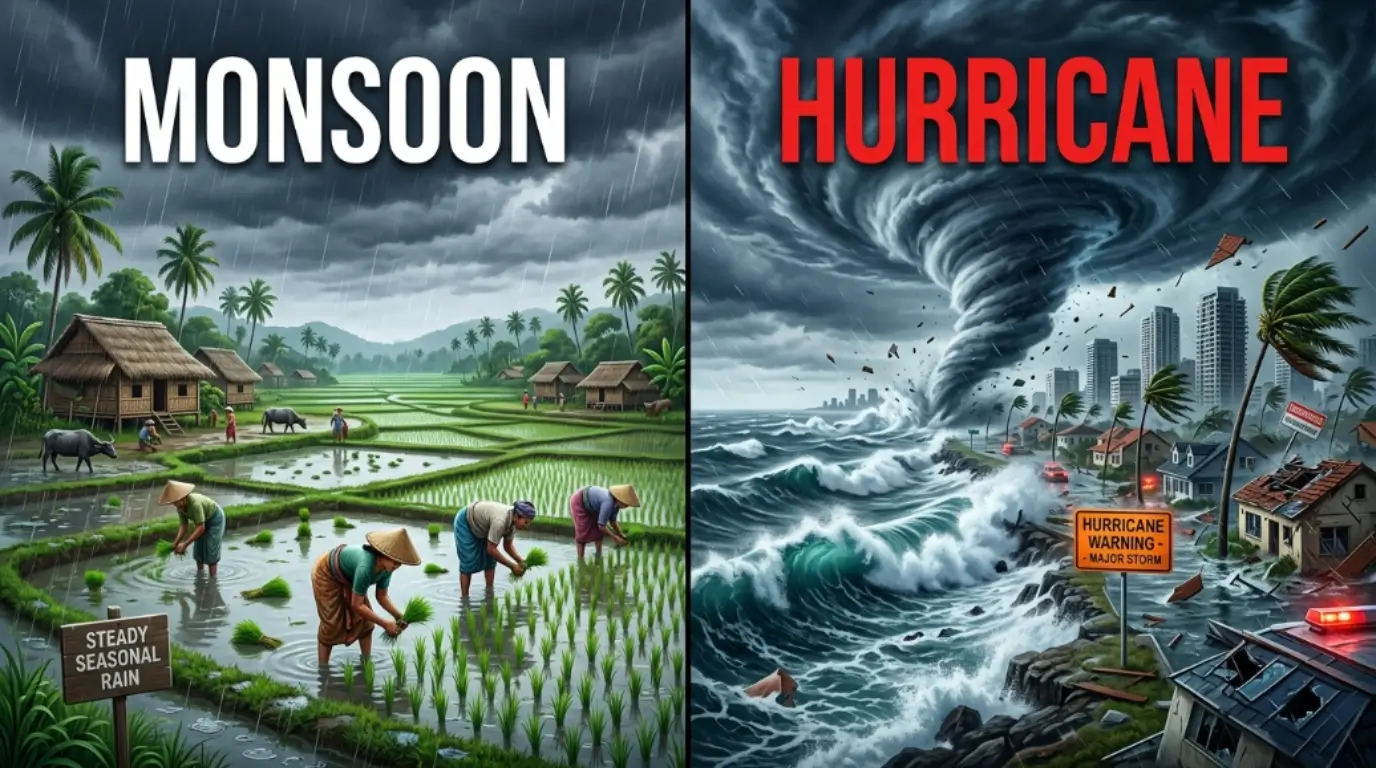
When people hear the words monsoon and hurricane, they often think about heavy rain, strong winds, and dangerous weather.
In many parts of the world, families wait for the monsoon season because it brings water for crops and daily life. Farmers in countries like India and Pakistan celebrate the arrival of monsoon rains because their fields depend on them.
On the other hand, people living near the Atlantic Ocean often fear hurricanes because these storms can destroy homes, roads, and cities within hours.
This real-world example clearly shows the difference between monsoon and hurricane. Although both are related to weather, they are completely different in formation, behavior, and effects.
Understanding the difference between monsoon and hurricane is important for students, travelers, scientists, and weather experts. The difference between monsoon and hurricane also helps societies prepare for disasters and protect human life.
Learning the difference between monsoon and hurricane improves weather awareness and helps people make safer decisions.
Pronunciation
Monsoon
- US: /mɑːnˈsuːn/
- UK: /mɒnˈsuːn/
Hurricane
- US: /ˈhɜːrɪkeɪn/
- UK: /ˈhʌrɪkən/
Weather events affect daily life, farming, travel, and even economies. To fully understand their role in nature, let us explore the major differences between monsoon and hurricane in detail.
Key Difference Between Monsoon and Hurricane
A monsoon is a seasonal weather pattern that brings heavy rainfall over a large area for several months. A hurricane is a powerful rotating tropical storm with extremely strong winds and heavy rain that lasts for a shorter time.
Monsoons are usually beneficial because they provide water for farming and rivers. Hurricanes are often destructive because they cause flooding, strong winds, and severe damage to buildings and coastal regions.
Why Is Their Difference Necessary to Know?
Understanding the difference between monsoon and hurricane is important for both learners and experts. Students learn how weather systems affect the environment and human life. Weather experts use this knowledge to predict storms and warn people about dangers.
Farmers depend on monsoon rains for crops, while coastal communities prepare for hurricanes to protect lives and property. Governments also use weather information to plan disaster management, rescue operations, and food production. Knowing the difference helps society stay safe and prepared.
Difference Between Monsoon and Hurricane
| Point of Difference | Monsoon | Hurricane |
| Definition | Seasonal wind and rain system | Powerful tropical storm |
| Duration | Lasts for months | Lasts for days or weeks |
| Wind Speed | Moderate winds | Extremely strong winds |
| Formation Area | Large land and ocean regions | Warm tropical oceans |
| Shape | No circular eye structure | Circular storm with an eye |
| Purpose in Nature | Supports agriculture and water supply | Mostly destructive weather event |
| Rainfall | Continuous seasonal rain | Intense storm rainfall |
| Damage Level | Can cause floods but also benefits farming | Causes severe destruction |
| Movement | Seasonal climate shift | Rotating storm movement |
| Common Regions | South Asia, Africa, Australia | Atlantic and Pacific coastal areas |
1. Difference in Definition
A monsoon is a seasonal change in wind patterns that brings rain. A hurricane is a strong tropical cyclone with rotating winds.
Examples of Monsoon
- South Asian summer monsoon
- West African monsoon
Examples of Hurricane
- Hurricane Katrina
- Hurricane Sandy
2. Difference in Duration
Monsoons continue for several months during rainy seasons. Hurricanes usually last for a few days or weeks.
Examples of Monsoon
- India receives monsoon rain from June to September
- Pakistan experiences seasonal monsoon rains
Examples of Hurricane
- Hurricane Irma lasted about two weeks
- Hurricane Harvey remained active for several days
3. Difference in Wind Speed
Monsoon winds are usually steady and moderate. Hurricane winds are violent and extremely powerful.
Examples of Monsoon
- Gentle monsoon winds cool hot weather
- Seasonal winds bring clouds inland
Examples of Hurricane
- Hurricane winds can exceed 150 mph
- Strong winds uproot trees and damage buildings
4. Difference in Formation
Monsoons form because of temperature differences between land and sea. Hurricanes form over warm tropical oceans.
Examples of Monsoon
- Hot land attracts moist ocean air
- Seasonal heating changes wind direction
Examples of Hurricane
- Warm ocean water fuels hurricanes
- Tropical storms grow stronger over the sea
5. Difference in Shape
Monsoons spread over wide regions without a fixed shape. Hurricanes have a spiral shape with a clear eye.
Examples of Monsoon
- Rain clouds cover large areas
- Seasonal rain bands spread across countries
Examples of Hurricane
- The eye of the hurricane remains calm
- Spiral clouds rotate around the center
6. Difference in Impact
Monsoons mostly help farming and water supply. Hurricanes mainly cause destruction.
Examples of Monsoon
- Farmers grow rice during monsoon season
- Rivers fill with fresh water
Examples of Hurricane
- Coastal flooding destroys homes
- Strong storms damage roads and power lines
7. Difference in Rainfall
Monsoon rainfall is seasonal and widespread. Hurricane rainfall is intense and concentrated.
Examples of Monsoon
- Daily seasonal rain supports crops
- Rainfall continues for weeks
Examples of Hurricane
- Heavy rain causes flash floods
- Storm rain falls rapidly in a short time
8. Difference in Movement
Monsoons move with seasonal climate patterns. Hurricanes travel as rotating storm systems.
Examples of Monsoon
- Monsoon winds shift every season
- Rain belts move across regions
Examples of Hurricane
- Hurricanes move toward coastlines
- Storms change direction with ocean winds
9. Difference in Areas Affected
Monsoons affect entire regions and countries. Hurricanes mostly affect coastal and island areas.
Examples of Monsoon
- South Asia depends on monsoon rainfall
- African regions experience seasonal rain
Examples of Hurricane
- Caribbean islands face hurricanes
- Gulf Coast regions experience tropical storms
10. Difference in Predictability
Monsoons are seasonal and easier to predict. Hurricanes can suddenly grow stronger and become dangerous.
Examples of Monsoon
- Weather departments announce monsoon seasons
- Farmers prepare for rainy months
Examples of Hurricane
- Storm categories change quickly
- Emergency evacuations may happen suddenly
Nature and Behaviour of Both
Nature and Behaviour of Monsoon
Monsoons are seasonal weather systems connected with climate changes. They usually bring heavy rainfall, humidity, and cloudy weather. Monsoons are slow-moving and cover large regions for long periods.
Nature and Behaviour of Hurricane
Hurricanes are violent tropical storms with rotating winds and powerful rainfall. They form quickly over warm oceans and can become extremely dangerous. Hurricanes are intense, destructive, and unpredictable.
Why People Are Confused About Their Use?
People often confuse monsoons and hurricanes because both involve rain, storms, and strong winds. News reports may also use weather terms in similar ways, which creates misunderstanding. Another reason is that both can cause flooding and damage. However, a monsoon is a seasonal weather pattern, while a hurricane is a single storm system.
Difference and Similarity Between Monsoon and Hurricane
| Feature | Monsoon | Hurricane | Similarity |
| Weather Type | Seasonal climate system | Tropical storm | Both involve rain and wind |
| Duration | Months | Days or weeks | Both affect weather conditions |
| Wind Strength | Moderate | Very strong | Both include moving air systems |
| Damage | Moderate to severe flooding | Extreme destruction | Both can cause floods |
| Importance | Helpful for farming | Dangerous natural disaster | Both influence human life |
Which Is Better in What Situation?
Monsoon
Monsoons are better for agriculture, water storage, and environmental balance. Many countries depend on monsoon rainfall for crops, drinking water, and electricity production. Without monsoons, farming industries would suffer badly.
Hurricane
Hurricanes are not considered beneficial in most situations because they are destructive. However, scientists study hurricanes to improve weather forecasting and disaster preparation. Hurricanes also help redistribute heat from tropical oceans to cooler regions.
How the Keywords Are Used in Metaphors and Similes
Monsoon in Metaphors and Similes
- “Her tears fell like a monsoon.”
- “The crowd entered like a monsoon of energy.”
Hurricane in Metaphors and Similes
- “His anger was a hurricane.”
- “The news hit her like a hurricane.”
Connotative Meaning of Both Keywords
Monsoon
- Positive: Growth, fertility, life
- Negative: Floods, mud, travel problems
- Neutral: Seasonal weather event
Example:
“The monsoon brought hope to dry villages.”
Hurricane
- Positive: Power, force
- Negative: Destruction, danger, fear
- Neutral: Tropical storm system
Example:
“The hurricane damaged the coastal town badly.”
Idioms or Proverbs Related to the Words
Monsoon Examples
- “Waiting like a farmer waits for the monsoon.”
- “The monsoon of success finally arrived.”
Hurricane Examples
- “Calm before the hurricane.”
- “She entered the room like a hurricane.”
Works in Literature
Monsoon
- The Monsoon — Wilbur Smith — Adventure — 1999
- Monsoon Summer — Mitali Perkins — Fiction — 2004
Hurricane
- Their Eyes Were Watching God — Zora Neale Hurston — Fiction — 1937
- Hurricane Season — Fernanda Melchor — Novel — 2017
Movies Related to Monsoon and Hurricane
Monsoon Movies
- Monsoon Wedding — 2001 — India
- Monsoon — 2019 — United Kingdom
Hurricane Movies
- The Hurricane — 1999 — USA
- Hurricane Heist — 2018 — USA
Frequently Asked Questions
1. What is the main difference between monsoon and hurricane?
A monsoon is a seasonal rain system, while a hurricane is a powerful tropical storm.
2. Which is more dangerous, monsoon or hurricane?
Hurricanes are usually more dangerous because of their powerful winds and destruction.
3. Can monsoons cause flooding?
Yes, heavy monsoon rains can lead to floods in many areas.
4. Where do hurricanes mostly occur?
Hurricanes mostly form over warm tropical oceans near coastal regions.
5. Why are monsoons important?
Monsoons provide water for farming, rivers, and daily human needs.
How Both Are Useful for Surroundings
Monsoons help maintain water supplies, support farming, and cool the environment. They are important for forests, rivers, and crop production. Hurricanes, although destructive, play a role in balancing global heat by moving warm air and water across oceans. Scientists also learn valuable information from studying hurricanes, which improves weather forecasting systems.
Final Words
The difference between monsoon and hurricane is important in weather studies, environmental science, and daily life.
Monsoons are seasonal climate systems that mostly benefit agriculture and water resources, while hurricanes are dangerous tropical storms that can cause severe destruction.
Both influence human society in different ways and teach us how powerful nature can be.
Understanding these weather events helps people prepare for natural changes, stay safe during disasters, and appreciate the importance of climate systems in the world.