Imagine a school principal making announcements. Sometimes, the principal speaks to every student in the school using loudspeakers. Other times, only students from Class 10 are called to the hall for a special meeting.
This simple situation explains the difference between multicast and broadcast in computer networking.
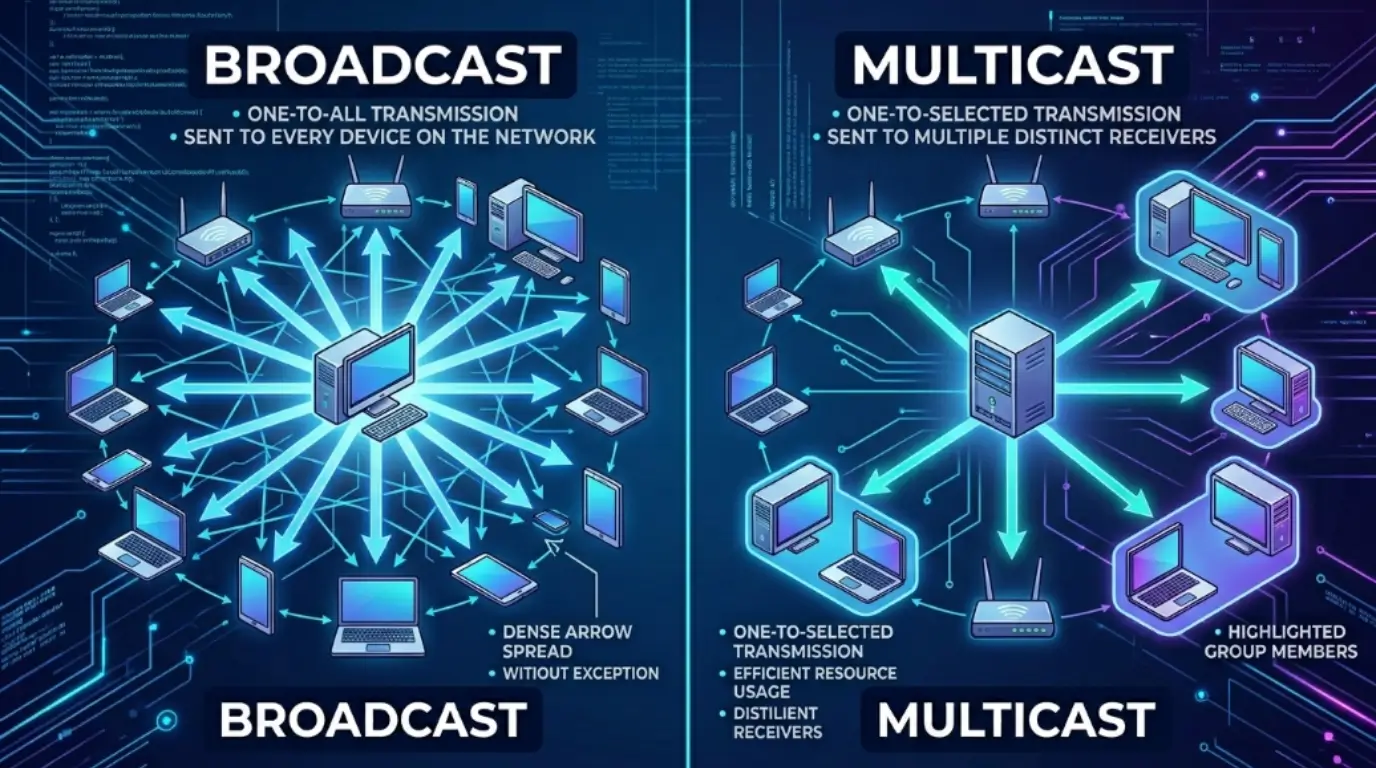
Broadcast sends data to every device in a network, while multicast sends data only to selected groups of devices.
Understanding the difference between multicast and broadcast helps students, IT experts, and network engineers manage internet traffic more efficiently.
In today’s digital world, streaming services, online gaming, and live video calls all depend on these communication methods.
Learning the difference between multicast and broadcast is important because it improves network speed, saves bandwidth, and reduces unnecessary traffic.
Many beginners confuse these terms because both involve sending data to multiple devices at once.
Pronunciation
- Multicast
- US: /ˈmʌl.ti.kæst/
- UK: /ˈmʌl.ti.kɑːst/
- Broadcast
- US: /ˈbrɔːd.kæst/
- UK: /ˈbrɔːd.kɑːst/
Before exploring the technical details, let’s understand how multicast and broadcast differ in real networking environments.
Key Difference Between Multicast and Broadcast
The main difference is that broadcast sends information to all devices, while multicast sends information only to selected devices in a group. Broadcast creates more traffic because every device receives the data, even if it is unnecessary. Multicast is more efficient because only interested devices receive the information.
Why Is Their Difference Necessary to Know?
Understanding multicast and broadcast is useful for students, network engineers, businesses, and software developers. Broadcast is important for device discovery and communication in small networks. Multicast is valuable for video streaming, online classes, and conferencing because it reduces bandwidth use.
Knowing their difference helps experts:
- Improve network performance
- Reduce unnecessary traffic
- Save bandwidth costs
- Increase communication efficiency
- Build scalable systems for modern technology
Difference Between Multicast and Broadcast
| Feature | Multicast | Broadcast |
| 1. Target Audience | Sends data to selected groups | Sends data to all devices |
| Example | Online webinar viewers | Office-wide printer discovery |
| Another Example | IPTV subscribers | Router announcements |
| 2. Traffic Load | Lower traffic | Higher traffic |
| Example | Zoom group meeting | Network-wide ARP request |
| Another Example | Live sports streaming | System update notification |
| 3. Efficiency | More efficient | Less efficient |
| Example | Video conferencing | Public network alerts |
| Another Example | Multiplayer gaming groups | Emergency LAN messages |
| 4. Bandwidth Usage | Saves bandwidth | Uses more bandwidth |
| Example | Streaming services | General announcements |
| Another Example | Smart classroom systems | Device scanning |
| 5. Receiver Selection | Devices join voluntarily | All devices receive automatically |
| Example | Subscribers join a stream | Every PC gets a packet |
| Another Example | Gaming servers | Wi-Fi discovery signals |
| 6. Network Impact | Reduced congestion | Can slow networks |
| Example | IPTV system | Heavy office LAN traffic |
| Another Example | Corporate meetings | Public hotspot traffic |
| 7. Address Type | Uses multicast IP addresses | Uses broadcast address |
| Example | 224.0.0.1 | 255.255.255.255 |
| Another Example | Group communication | Universal transmission |
| 8. Scalability | Better for large networks | Poor for large networks |
| Example | Cloud streaming | Small local network |
| Another Example | Global webinars | Classroom network |
| 9. Security | More controlled | Less secure |
| Example | Authorized subscribers | Open announcements |
| Another Example | Enterprise streaming | Public device discovery |
| 10. Main Purpose | Group communication | Network-wide communication |
| Example | Live lectures | System announcements |
| Another Example | Online conferences | Device identification |
Nature and Behaviour of Both
Multicast
Multicast behaves like a private club. Only selected members receive the information. It is controlled, efficient, and organized. Devices must join the multicast group before receiving data.
Broadcast
Broadcast behaves like a public loudspeaker. Every device hears the message whether it needs it or not. It is simple but creates more network traffic.
Why Are People Confused About Their Use?
People often confuse multicast and broadcast because both send data to multiple devices at the same time. Beginners think they work the same way since both involve group communication. The confusion increases because both are used in networking systems and internet communication.
Difference and Similarity Table
| Aspect | Multicast | Broadcast | Similarity |
| Communication Type | Group-based | Network-wide | Both send data to multiple devices |
| Efficiency | High | Low | Both support communication |
| Traffic | Controlled | Heavy | Both use network resources |
| Bandwidth | Saves bandwidth | Consumes more bandwidth | Both transfer packets |
| Usage | Streaming and conferencing | Device discovery | Both are networking methods |
Which Is Better in What Situation?
Multicast
Multicast is better for video streaming, online meetings, IPTV, and gaming servers. It works well when only specific users need the information. It reduces traffic and saves internet bandwidth.
Broadcast
Broadcast is better for small local networks where every device must receive the message. It is commonly used for network discovery and communication setup between devices.
How the Keywords Are Used in Metaphors and Similes
Multicast
- “The teacher’s selective advice spread like multicast to only interested students.”
- “Her message moved through the group like a multicast signal.”
Broadcast
- “The news spread like a broadcast across the town.”
- “His loud voice worked like a broadcast station.”
Connotative Meaning
Multicast
- Positive: Efficient, selective, organized
- Neutral: Group communication system
- Negative: Limited accessibility
Example:
“The company used multicast to improve streaming quality.”
Broadcast
- Positive: Wide communication, openness
- Neutral: Public transmission
- Negative: Overloading and disturbance
Example:
“The broadcast message slowed the office network.”
Idioms or Proverbs Related to the Words
Broadcast
- “Spread the word”
- “He broadcasted the rumor everywhere.”
Multicast
There are no common English idioms directly related to multicast, but technical expressions are often used.
- “The server multicasted updates to subscribers.”
Works in Literature
Multicast
- Computer Networks — Andrew S. Tanenbaum (Networking, 1981)
- Data Communications and Networking — Behrouz Forouzan (Education, 1998)
Broadcast
- Broadcast News — Susan Douglas (Media Studies, 1999)
- The Broadcast Century — Robert McChesney (History, 2001)
Movie Names Related to the Keywords
Broadcast
- Broadcast News (1987, USA)
- Newsroom Broadcast (2019, UK)
Multicast
There are no famous mainstream movies directly named “Multicast,” but the term appears in networking documentaries and technology programs.
Frequently Asked Questions
1. What is the main difference between multicast and broadcast?
Broadcast sends data to all devices, while multicast sends data only to selected groups.
2. Which is more efficient?
Multicast is more efficient because it reduces unnecessary traffic.
3. Where is broadcast commonly used?
Broadcast is commonly used in local area networks for device discovery.
4. Why is multicast important?
Multicast is important for streaming, conferencing, and online gaming because it saves bandwidth.
5. Can multicast and broadcast work together?
Yes, both can exist in the same network for different communication purposes.
How Both Are Useful for Surroundings
Multicast and broadcast both support modern digital communication. Broadcast helps devices discover each other in local networks. Multicast supports online education, live streaming, gaming, and video conferencing. Together, they improve communication systems and make networking technology more practical and efficient.
Final Words
The difference between multicast and broadcast is important in computer networking and digital communication.
Broadcast sends messages to everyone, while multicast targets only selected groups. Both methods have unique purposes and advantages depending on the situation.
Broadcast is simple and useful for small networks, while multicast is efficient and better for large-scale communication systems.
Understanding their differences helps students and professionals build better and faster networks.
In today’s connected world, learning the difference between multicast and broadcast can improve technical knowledge and make communication systems more effective.