During an important meeting at work, a manager asked an employee if the project details were correct. The employee confidently replied, “I affirm that the information is accurate.”
Later, the manager checked the records and sent a message saying, “I confirm the meeting schedule for tomorrow.”
These two responses sounded similar, but they had slightly different meanings. This simple situation explains why many learners search for the difference between affirm and confirm.
The words affirm and confirm both relate to stating that something is true, but they are used in different contexts. Understanding the difference between affirm and confirm helps people communicate more precisely in professional, legal, and everyday conversations.
The difference between affirm and confirm is especially useful for students, writers, and professionals who want to avoid confusion.
When people understand the difference between affirm and confirm, they can express certainty and verification more clearly.
Key Difference Between the Two
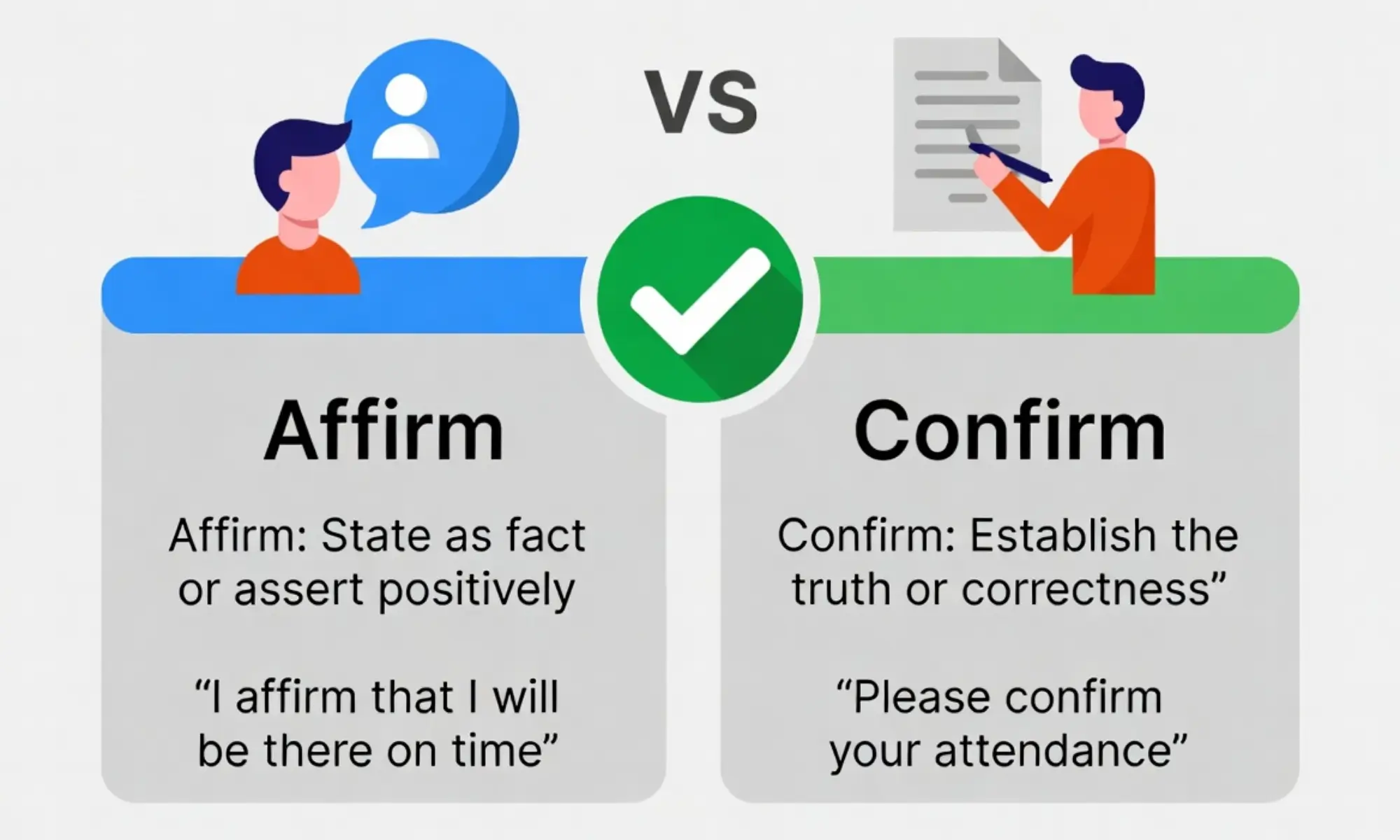
The main difference between affirm and confirm is that affirm means to state something strongly or publicly as true, while confirm means to verify or check that something is correct.
Why Knowing Their Difference Is Important
Knowing this difference improves communication skills. In professional settings, using the correct word shows clarity and confidence. For example, lawyers, journalists, teachers, and business professionals often rely on precise language. Understanding these words also helps students and language learners develop stronger writing and speaking skills.
Pronunciation
Affirm
- US: /əˈfɝːm/
- UK: /əˈfɜːm/
Confirm
- US: /kənˈfɝːm/
- UK: /kənˈfɜːm/
Now that the meanings are clear, let us explore the detailed difference between affirm and confirm.
Difference Between Affirm and Confirm
1. Basic Meaning
Affirm means to state something confidently as true. Confirm means to verify that something is correct.
Examples (Affirm)
- The witness affirmed his statement in court.
- She affirmed her support for the project.
Examples (Confirm)
- The airline confirmed the flight booking.
- The manager confirmed the meeting time.
2. Purpose
Affirm focuses on expressing belief or confidence. Confirm focuses on verifying information.
Examples (Affirm)
- A leader affirming commitment to a cause.
- A person affirming personal values.
Examples (Confirm)
- Checking appointment details.
- Verifying hotel reservations.
3. Context of Use
Affirm is common in formal, legal, or emotional statements. Confirm is common in everyday verification.
Examples (Affirm)
- A judge asking someone to affirm their testimony.
- A politician affirming a promise.
Examples (Confirm)
- Confirming a package delivery.
- Confirming a doctor’s appointment.
4. Emotional Strength
Affirm often expresses strong belief or support. Confirm is more neutral and factual.
Examples (Affirm)
- Affirming faith in someone’s abilities.
- Affirming commitment to a relationship.
Examples (Confirm)
- Confirming exam results.
- Confirming travel dates.
5. Communication Style
Affirm is expressive and declarative. Confirm is practical and informational.
Examples (Affirm)
- “I affirm my dedication to the team.”
- “The organization affirmed its mission.”
Examples (Confirm)
- “Please confirm your email address.”
- “The company confirmed the event location.”
6. Evidence Requirement
Affirm does not always require evidence. Confirm usually requires proof or verification.
Examples (Affirm)
- A person affirming loyalty to a friend.
- A leader affirming confidence in the team.
Examples (Confirm)
- Confirming facts with documents.
- Confirming results with research.
7. Usage in Legal Situations
Affirm is used in legal declarations. Confirm is used in official verification.
Examples (Affirm)
- Witnesses affirm statements in court.
- People affirm an oath.
Examples (Confirm)
- Authorities confirm an investigation result.
- Officials confirm legal documents.
8. Frequency in Daily Language
Affirm is less common in casual conversation. Confirm is used frequently.
Examples (Affirm)
- Affirming personal beliefs.
- Affirming values in speeches.
Examples (Confirm)
- Confirming dinner reservations.
- Confirming attendance at events.
9. Tone
Affirm has a supportive or declarative tone. Confirm has a verifying tone.
Examples (Affirm)
- Affirming encouragement to a colleague.
- Affirming someone’s rights.
Examples (Confirm)
- Confirming technical details.
- Confirming financial transactions.
10. Outcome
Affirm expresses confidence or belief. Confirm establishes factual accuracy.
Examples (Affirm)
- A teacher affirming a student’s effort.
- A speaker affirming cultural values.
Examples (Confirm)
- Confirming weather forecasts.
- Confirming event schedules.
Nature and Behaviour of Both
Nature of Affirm
Affirm is expressive and often emotional. It reflects strong belief, agreement, or support. People use it to express certainty or commitment.
Nature of Confirm
Confirm is factual and practical. It involves checking and verifying information to ensure accuracy.
Why People Are Confused About Their Use
People often confuse these words because both relate to agreeing that something is true. However, affirm focuses on declaring belief, while confirm focuses on verifying facts.
Table: Difference and Similarity
| Feature | Affirm | Confirm |
| Meaning | Declare something true | Verify something is correct |
| Tone | Strong and expressive | Neutral and factual |
| Context | Legal or emotional statements | Everyday verification |
| Evidence | Not always required | Usually required |
| Similarity | Both indicate agreement or truth |
Which Is Better in What Situation?
When Affirm Is Better
Affirm is useful when expressing strong belief or support. For example, leaders often affirm their commitment to a cause or team.
When Confirm Is Better
Confirm is better when verifying information or details. It is commonly used in professional communication, travel arrangements, and official documentation.
Metaphors and Similes
Affirm
- “Affirming a promise is like planting a flag of confidence.”
- “Her words affirmed his efforts like sunlight encouraging growth.”
Confirm
- “Confirming information is like checking a map before a journey.”
- “It works like a stamp of approval.”
Connotative Meaning
Affirm
- Positive: support, confidence
- Neutral: declaration
- Negative: rarely negative
Example: “The leader affirmed his loyalty to the community.”
Confirm
- Positive: accuracy, reliability
- Neutral: verification
- Negative: sometimes seen as formal
Example: “The email confirmed the appointment details.”
Idioms or Proverbs
Examples related to truth and agreement:
- “Actions speak louder than words.”
- “Trust but verify.”
- “Seeing is believing.”
Works in Literature
- On Truth — Philosophy — Friedrich Nietzsche — 1873
- The Elements of Style — Writing Guide — William Strunk Jr. & E.B. White — 1918
Movies Related to Truth and Verification
- A Few Good Men — 1992 — USA
- Spotlight — 2015 — USA
Frequently Asked Questions
1. What is the main difference between affirm and confirm?
Affirm means declaring something as true, while confirm means verifying that it is correct.
2. Are the words interchangeable?
Sometimes, but they usually serve different purposes.
3. Which word is more common in everyday use?
Confirm is more commonly used.
4. Is affirm used in legal situations?
Yes, it is often used when declaring statements or oaths.
5. Why are both words useful in communication?
They help express certainty and verify information clearly.
Conclusion
The difference between affirm and confirm lies in their purpose and tone. Affirm focuses on declaring belief or support, while confirm focuses on verifying facts and ensuring accuracy. Both words help people communicate certainty, but they serve different roles in language.
By understanding the difference between affirm and confirm, learners and professionals can choose the correct word in different contexts.
This knowledge improves writing clarity, strengthens communication, and helps avoid misunderstandings in both formal and everyday conversations.