Imagine a small shop owner checking the business accounts at the end of the day. Money came in from customers, and money went out to pay suppliers.
To keep everything organized, the owner recorded every transaction using debits and credits. This simple accounting system helps businesses track their finances accurately.
Understanding the difference between debits and credits is one of the most important parts of accounting.
Whether you are a student, business owner, accountant, or finance professional, knowing the difference between debits and credits helps you record transactions correctly.
The difference between debits and credits forms the foundation of double-entry bookkeeping and financial reporting.
Without understanding the difference between debits and credits, financial records can quickly become confusing and inaccurate.
Before exploring the details, let’s learn how these important accounting terms are pronounced.
Pronunciation of Debits and Credits
| Term | US Pronunciation | UK Pronunciation |
| Debit | DEB-it | DEB-it |
| Credit | KRED-it | KRED-it |
Now that we know what they sound like, let’s explore how they work together in accounting.
Key Difference Between Debits and Credits
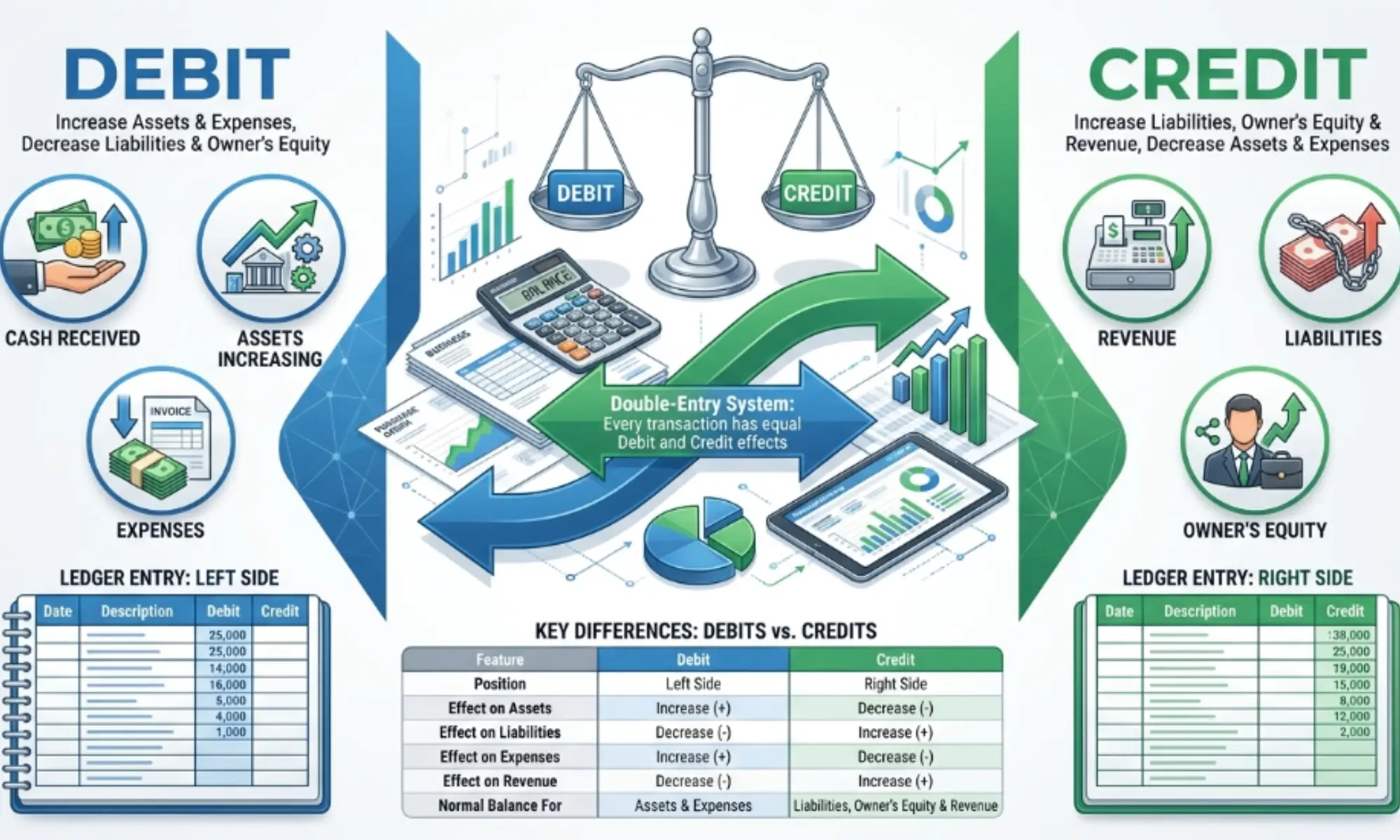
A debit is an accounting entry recorded on the left side of an account, while a credit is recorded on the right side. Debits and credits work together to keep accounting records balanced.
For example:
- When a business purchases equipment with cash, the equipment account is debited.
- The cash account is credited because cash decreases.
Every financial transaction affects at least two accounts through debits and credits.
Why Is Their Difference Necessary to Know?
Understanding debits and credits is important for learners and experts because:
- It ensures accurate financial reporting.
- It helps businesses monitor profits and losses.
- It prevents accounting errors.
- It supports tax preparation.
- It improves financial decision-making.
- It creates transparency in organizations.
- It helps investors evaluate business performance.
- It forms the basis of accounting education worldwide.
Without understanding debits and credits, financial records become unreliable and difficult to interpret.
Debits vs Credits: 10 Key Differences
1. Position in the Account
Debit
Debits are recorded on the left side of an account.
Examples:
- Debit Cash when money is received.
- Debit Equipment when machinery is purchased.
Credit
Credits are recorded on the right side of an account.
Examples:
- Credit Sales Revenue when products are sold.
- Credit Cash when paying a supplier.
2. Effect on Assets
Debit
Debits increase asset accounts.
Examples:
- Buying inventory.
- Receiving cash from customers.
Credit
Credits decrease asset accounts.
Examples:
- Paying rent with cash.
- Selling equipment.
3. Effect on Liabilities
Debit
Debits decrease liabilities.
Examples:
- Paying off a loan.
- Settling accounts payable.
Credit
Credits increase liabilities.
Examples:
- Taking a bank loan.
- Purchasing goods on credit.
4. Effect on Revenue
Debit
Debits decrease revenue accounts.
Examples:
- Sales returns.
- Revenue corrections.
Credit
Credits increase revenue accounts.
Examples:
- Product sales.
- Service income.
5. Effect on Expenses
Debit
Debits increase expenses.
Examples:
- Paying salaries.
- Paying utility bills.
Credit
Credits decrease expenses.
Examples:
- Refund of an expense.
- Expense adjustment.
6. Role in Double-Entry Accounting
Debit
One side of every transaction.
Examples:
- Debit Inventory.
- Debit Rent Expense.
Credit
The balancing side of every transaction.
Examples:
- Credit Cash.
- Credit Accounts Payable.
7. Impact on Owner’s Equity
Debit
Debits reduce owner’s equity.
Examples:
- Owner withdrawals.
- Loss adjustments.
Credit
Credits increase owner’s equity.
Examples:
- Owner investment.
- Profit transfers.
8. Purpose
Debit
Records incoming value or increased resources.
Examples:
- Receiving cash.
- Acquiring equipment.
Credit
Records outgoing value or increased obligations.
Examples:
- Loan received.
- Cash paid out.
9. Financial Statement Influence
Debit
Often increases assets and expenses.
Examples:
- Office supplies purchase.
- Insurance payment.
Credit
Often increases liabilities and revenues.
Examples:
- Service revenue earned.
- Loan proceeds received.
10. Accounting Balance
Debit
Must equal total credits.
Examples:
- Debit Cash $500.
- Debit Equipment $1,000.
Credit
Must equal total debits.
Examples:
- Credit Revenue $500.
- Credit Cash $1,000.
Nature and Behaviour of Debits
Debits generally increase assets and expenses while decreasing liabilities, equity, and revenue. They are recorded on the left side of accounts and represent resources entering the business or expenses incurred during operations.
Nature and Behaviour of Credits
Credits generally increase liabilities, owner’s equity, and revenue while decreasing assets and expenses. They appear on the right side of accounts and often represent obligations, income, or resources leaving the business.
Why Are People Confused About Their Use?
People often assume that a debit always means money leaving an account and a credit always means money entering an account. While this may be true in personal banking, accounting follows different rules. The effect of a debit or credit depends on the type of account involved, which causes confusion among beginners.
Difference and Similarity Table
| Feature | Debit | Credit | Similarity |
| Position | Left side | Right side | Both are accounting entries |
| Assets | Increase | Decrease | Affect asset accounts |
| Liabilities | Decrease | Increase | Affect liability accounts |
| Revenue | Decrease | Increase | Affect income records |
| Expenses | Increase | Decrease | Affect profit calculations |
| Equity | Decrease | Increase | Affect owner’s interest |
| Role | One side of entry | Other side of entry | Both required in bookkeeping |
| Purpose | Record increases/decreases | Record increases/decreases | Track transactions |
| Balance | Must equal credits | Must equal debits | Maintain balance |
| Importance | Essential | Essential | Core accounting concepts |
Which Is Better in What Situation?
Neither debits nor credits are better than the other because both are necessary for accurate accounting. Debits are useful when recording increases in assets or expenses. For example, purchasing equipment requires a debit entry to reflect the new asset.
Credits are useful when recording increases in revenue, liabilities, or owner’s equity. For example, earning revenue from sales requires a credit entry. In accounting, success comes from using both correctly rather than choosing one over the other.
Debits and Credits in Metaphors and Similes
Debit Metaphors
- A debit is the fuel entering a car’s tank.
- A debit is a seed planted for future growth.
- A debit is the foundation stone of a building.
Credit Metaphors
- A credit is the balance beam that keeps records steady.
- A credit is the mirror image of a debit.
- A credit is the other half of an accounting equation.
Similes
- A debit is like adding water to a reservoir.
- A credit is like opening a gate to release water.
- Debits and credits work together like two sides of a coin.
Connotative Meaning
| Term | Connotation | Example |
| Debit | Neutral | The company debited the equipment account. |
| Credit | Generally Positive | The customer received credit for timely payment. |
Idioms and Proverbs Related to the Words
Debit
- Debit the account of experience.
- Every debit has a matching credit.
Credit
- Give credit where credit is due.
- Credit is better than cash in some situations.
- A good name is better than great credit.
Works in Literature Featuring Debits or Credits
Debits
- Accounting Principles – Jerry J. Weygandt – Educational – 2019
- Financial Accounting – Robert Libby – Educational – 2021
- Principles of Accounting – Belverd Needles – Educational – 2018
Credits
- Accounting Made Simple – Mike Piper – Educational – 2020
- The Accounting Game – Darrell Mullis – Educational – 2019
- Bookkeeping for Dummies – Lita Epstein – Educational – 2022
Movies Related to Accounting, Finance, and Credits
- The Accountant – 2016 – United States
- Margin Call – 2011 – United States
- The Big Short – 2015 – United States
- Wall Street – 1987 – United States
- Too Big to Fail – 2011 – United States
Frequently Asked Questions
What is the main difference between debits and credits?
Debits are recorded on the left side of an account, while credits are recorded on the right side.
Do debits always mean money coming in?
No. Debits can increase or decrease accounts depending on the account type.
Why must debits equal credits?
This keeps the accounting equation balanced and ensures accurate financial records.
Can a transaction have multiple debits and credits?
Yes. Complex transactions may involve several debit and credit entries.
Are debits bad and credits good?
No. Both are neutral accounting tools used to record financial transactions accurately.
How Both Are Useful for Surroundings
Debits and credits help businesses, governments, schools, hospitals, and non-profit organizations maintain accurate financial records. They improve accountability, reduce fraud, support budgeting, and help organizations make informed decisions. Their proper use contributes to financial stability and economic growth in society.
Conclusion
The difference between debits and credits is one of the most important concepts in accounting. Debits and credits work together to record every financial transaction accurately and maintain balance in financial records.
While debits typically increase assets and expenses, credits generally increase liabilities, equity, and revenue.
Understanding their differences helps students learn accounting fundamentals, enables businesses to maintain reliable records, and supports experts in making informed financial decisions.
Rather than competing concepts, debits and credits are complementary tools that form the backbone of modern accounting systems. Mastering them is essential for anyone involved in finance, bookkeeping, or business management.