Imagine a family cleaning their home after a picnic in the park. They carefully separate their waste into different bins and notice labels such as “biodegradable” and “compostable” on cups, plates, and bags. At first glance, these terms seem identical, but they are not.
Understanding the difference between biodegradable and compostable is important because it affects how waste is managed and how it impacts the environment.
The difference between biodegradable and compostable is often misunderstood by consumers, students, and even professionals.
While both materials break down naturally, they do so in different ways and under different conditions.
Learning the difference between biodegradable and compostable helps people make better environmental choices and reduce pollution.
This article explains the difference between biodegradable and compostable in simple language, covering definitions, examples, uses, similarities, and practical applications.
Key Difference Between Biodegradable and Compostable
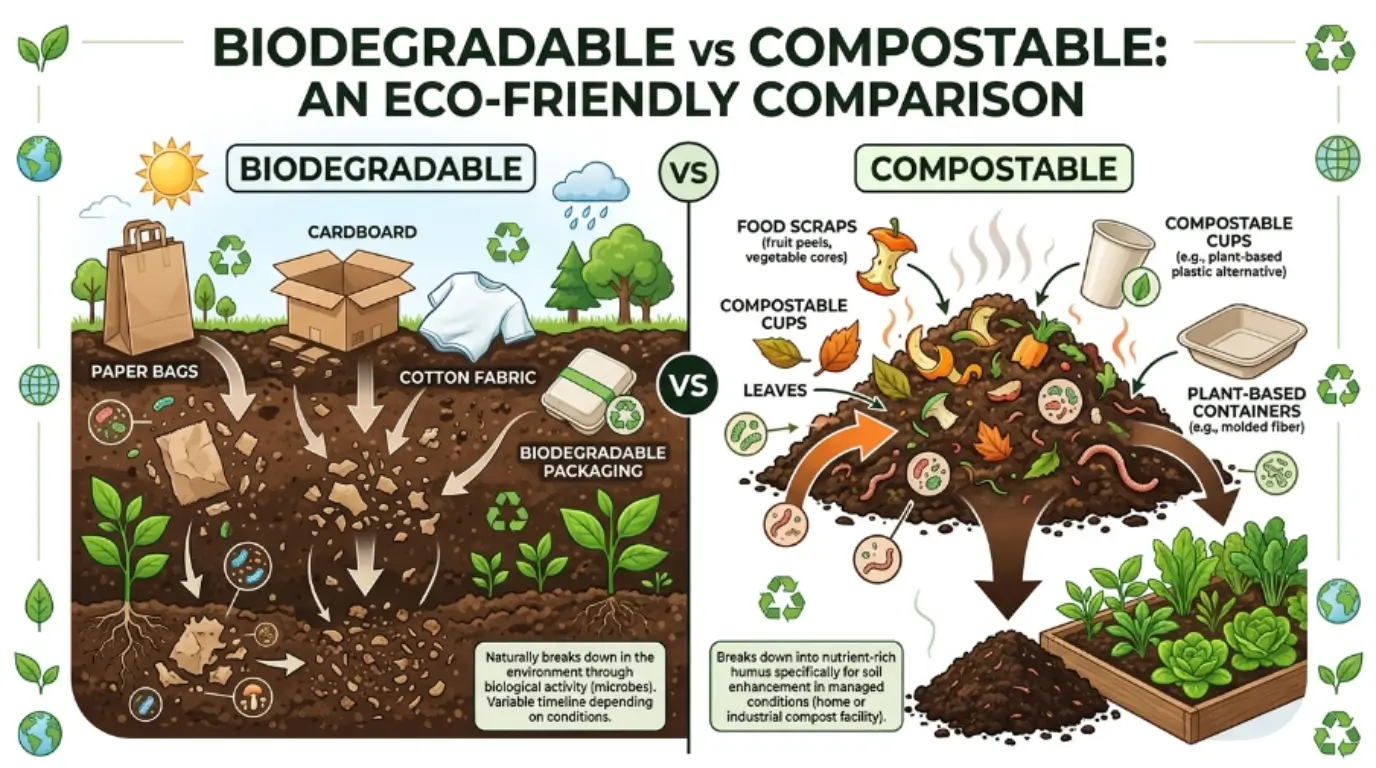
Biodegradable materials can be broken down naturally by microorganisms over time. However, there is usually no specific time limit for the process.
Compostable materials also break down naturally, but they must decompose within a specific period and leave behind nutrient-rich compost that benefits the soil.
Why Is Their Difference Important for Learners and Experts?
Understanding these terms helps consumers choose environmentally friendly products. Businesses can improve sustainability practices, while researchers and environmental experts can develop better waste management solutions.
In society, correct waste disposal reduces landfill pollution, conserves resources, and supports a cleaner environment. Knowing the difference helps prevent confusion and encourages responsible consumption.
Pronunciation
Biodegradable
- US: /ˌbaɪ.oʊ.dɪˈɡreɪ.də.bəl/
- UK: /ˌbaɪ.əʊ.dɪˈɡreɪ.də.bəl/
Compostable
- US: /kəmˈpoʊ.stə.bəl/
- UK: /kəmˈpɒs.tə.bəl/
Now that we understand the basic definitions, let’s explore their differences in detail.
Difference Between Biodegradable and Compostable
1. Definition
Biodegradable: Can be broken down naturally by microorganisms.
Examples:
- Paper bags
- Cotton clothing
Compostable: Breaks down into nutrient-rich compost.
Examples:
- Compostable food containers
- Fruit peels
2. End Product
Biodegradable: Produces natural substances but may leave residues.
Examples:
- Wood decomposes into organic matter
- Cardboard breaks into fibers
Compostable: Produces beneficial compost.
Examples:
- Vegetable scraps become fertilizer
- Compostable coffee filters enrich soil
3. Time Required
Biodegradable: May take months, years, or decades.
Examples:
- Paper decomposes in months
- Wood may take years
Compostable: Usually decomposes within a controlled timeframe.
Examples:
- Food waste in compost bins
- Certified compostable packaging
4. Environmental Benefit
Biodegradable: Reduces waste but may not improve soil.
Examples:
- Natural fibers
- Plant-based products
Compostable: Improves soil quality.
Examples:
- Garden waste
- Compostable food scraps
5. Conditions Needed
Biodegradable: Can decompose in various environments.
Examples:
- Soil
- Water
Compostable: Requires composting conditions.
Examples:
- Compost facilities
- Home compost systems
6. Certification Standards
Biodegradable: Often lacks strict standards.
Examples:
- Some biodegradable plastics
- Natural materials
Compostable: Usually follows certification requirements.
Examples:
- Certified compost bags
- Certified food packaging
7. Impact on Soil
Biodegradable: May not add nutrients.
Examples:
- Biodegradable plastic films
- Certain paper products
Compostable: Enriches soil nutrients.
Examples:
- Composted leaves
- Composted food scraps
8. Waste Management
Biodegradable: Can still end up in landfills.
Examples:
- Biodegradable packaging
- Natural textiles
Compostable: Best suited for composting systems.
Examples:
- Compost bins
- Industrial compost facilities
9. Breakdown Process
Biodegradable: Breakdown speed varies greatly.
Examples:
- Paper products
- Natural fibers
Compostable: More predictable decomposition.
Examples:
- Compostable utensils
- Compostable containers
10. Sustainability Goal
Biodegradable: Focuses on natural decomposition.
Examples:
- Bamboo products
- Cotton materials
Compostable: Focuses on circular waste management.
Examples:
- Food scraps
- Compostable packaging
Nature and Behaviour of Both
Biodegradable
Biodegradable materials naturally decompose through the action of bacteria, fungi, and other microorganisms. The process may occur slowly and does not always produce useful compost.
Compostable
Compostable materials behave similarly but are designed to decompose efficiently and safely. They leave behind nutrient-rich material that improves soil health.
Why Are People Confused About Their Use?
People often assume that biodegradable and compostable mean the same thing because both involve natural decomposition. Product labels sometimes use the terms without clear explanations. Since compostable materials are also biodegradable, many consumers mistakenly think the reverse is always true, which is not correct.
Difference and Similarity Table
| Feature | Biodegradable | Compostable | Similarity |
| Natural breakdown | Yes | Yes | Both decompose naturally |
| Produces compost | Not always | Yes | Organic decomposition |
| Improves soil | Sometimes | Yes | Environmentally friendly |
| Time requirement | Variable | Specific | Requires microorganisms |
| Certification | Often optional | Usually certified | Sustainable option |
| Waste reduction | Yes | Yes | Reduces pollution |
Which Is Better in What Situation?
When Biodegradable Is Better
Biodegradable products are useful when natural decomposition is the primary goal. They are suitable for materials that may not enter composting systems but still need to break down naturally over time.
When Compostable Is Better
Compostable products are better when proper composting facilities are available. They create valuable compost, improve soil quality, and support a circular economy. For environmental benefits, compostable products are often the preferred choice.
Biodegradable and Compostable in Metaphors and Similes
Biodegradable
Metaphors:
- His anger was biodegradable and disappeared with time.
- Old traditions became biodegradable under modern influences.
Similes:
- The rumor faded like biodegradable paper in the rain.
- Her sadness vanished like biodegradable leaves on the forest floor.
Compostable
Metaphors:
- Her experiences were compostable, turning hardship into growth.
- Failure became compostable fuel for success.
Similes:
- His lessons were like compostable waste, enriching future knowledge.
- Their teamwork grew like compostable matter feeding a garden.
Connotative Meanings
Biodegradable
Positive
- Eco-friendly
- Natural
- Sustainable
Example:
- The company switched to biodegradable packaging.
Neutral
- Material capable of decomposition.
Example:
- The label states the bag is biodegradable.
Negative
- May decompose too slowly.
Example:
- Some biodegradable plastics remain in landfills for years.
Compostable
Positive
- Soil-enriching
- Sustainable
- Regenerative
Example:
- Compostable products support healthy gardens.
Neutral
- Material suitable for composting.
Example:
- The cup is compostable.
Negative
- Requires proper disposal conditions.
Example:
- Compostable products may not break down properly in landfills.
Idioms or Proverbs Related to the Concepts
- Waste not, want not.
- One man’s trash is another man’s treasure.
- Reap what you sow.
- Every seed grows in its own time.
- Take care of the earth and it will take care of you.
Works in Literature Related to Environmental Themes
- Silent Spring — Environmental Nonfiction — Silent Spring — 1962
- Walden — Nature Literature — Walden — 1854
- The Overstory — Environmental Fiction — The Overstory — 2018
- A Sand County Almanac — Environmental Essays — A Sand County Almanac — 1949
Movies Related to Environmental Sustainability
- WALL-E — 2008 — USA
- The Lorax — 2012 — USA
- Before the Flood — 2016 — USA
- Kiss the Ground — 2020 — USA
Frequently Asked Questions
What is the main difference between biodegradable and compostable?
Biodegradable materials break down naturally, while compostable materials break down into nutrient-rich compost within specific conditions.
Are all compostable products biodegradable?
Yes. Every compostable product is biodegradable, but not every biodegradable product is compostable.
Which is better for the environment?
Compostable products are often better because they enrich soil and support sustainable waste management.
Can biodegradable plastic be composted?
Not always. Some biodegradable plastics require special conditions and may not produce compost.
Why do compostable products need special conditions?
They often require proper temperature, moisture, and microorganisms to break down efficiently.
How Both Are Useful for Surroundings
Both biodegradable and compostable materials help reduce environmental pollution. They decrease landfill waste, lower dependence on traditional plastics, and encourage sustainable living.
Compostable products additionally improve soil fertility, while biodegradable products reduce the long-term presence of waste in nature. Together, they support healthier ecosystems and a cleaner future.
Conclusion
The difference between biodegradable and compostable lies mainly in how materials break down and what remains after decomposition.
Biodegradable materials naturally decompose over time, while compostable materials break down under specific conditions and create nutrient-rich compost.
Understanding these terms helps consumers, businesses, and environmental professionals make informed decisions.
Both options contribute to sustainability, but compostable products often provide greater environmental benefits because they improve soil health and support circular waste systems.
By choosing the right products and disposing of them properly, everyone can contribute to a cleaner and greener world.