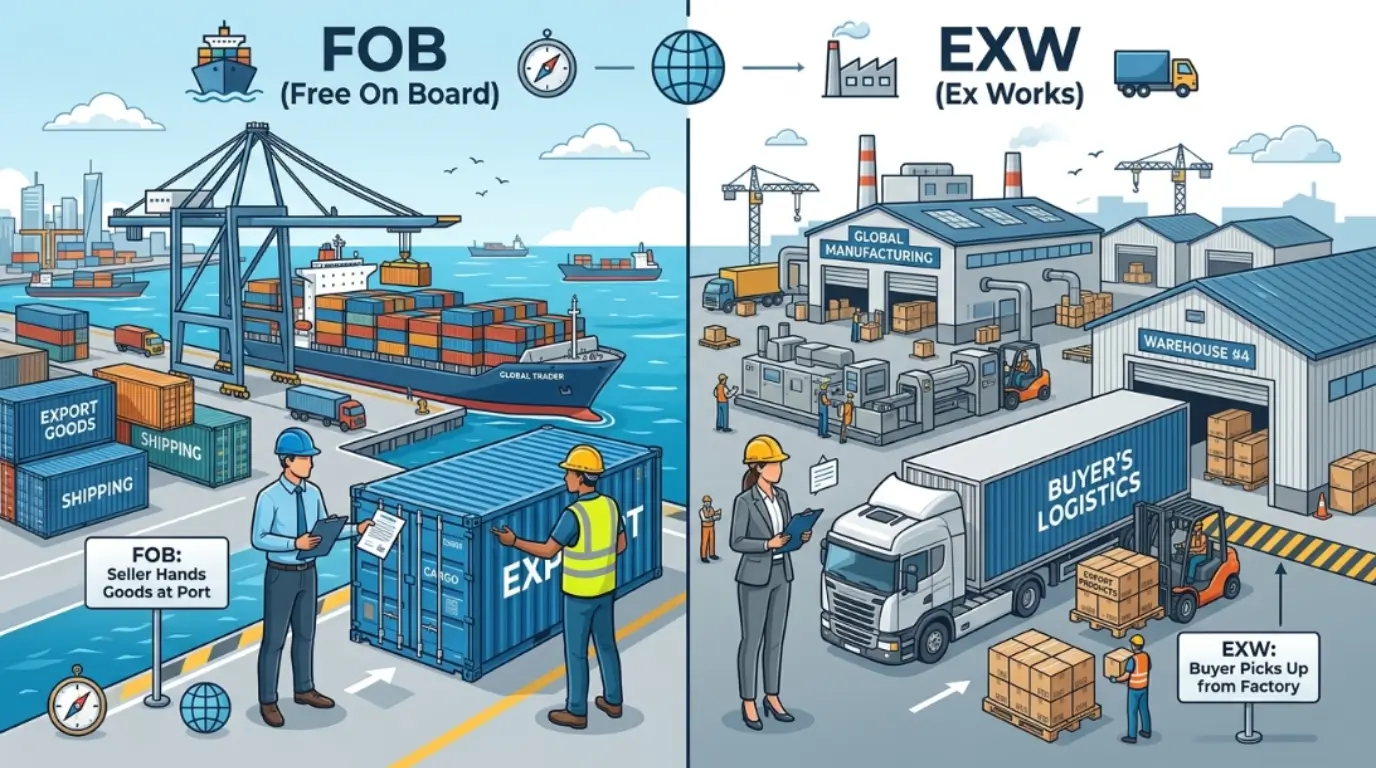
In global trade, terms like FOB (Free On Board) and EXW (Ex Works) decide who pays what, and who is responsible for goods during shipping. Imagine a small furniture seller in China shipping a wooden table to a buyer in the USA.
At what point does the responsibility shift from seller to buyer? That’s exactly where FOB and EXW come in. Many beginners often get confused between FOB and EXW because both define delivery responsibilities, but in very different ways.
Understanding FOB and EXW is essential for anyone in import-export business because these terms directly affect cost, risk, and logistics control.
In this guide, we will clearly explain FOB and EXW, their meaning, usage, and real-life importance so you never get confused again in international trade.
Key Difference Between FOB and EXW
The main difference between FOB and EXW is responsibility transfer. In FOB, the seller is responsible until goods are loaded onto the ship. In EXW, the seller’s responsibility ends as soon as goods are made available at their factory or warehouse.
- FOB: Seller handles transport to port + loading
- EXW: Buyer handles everything from seller’s location
Why Knowing FOB and EXW Is Important
Understanding FOB and EXW is very important for businesses, learners, and traders. These terms decide who pays shipping costs, who handles customs, and who bears risks if goods are damaged.
For example, a small business using FOB may save stress because the seller manages export logistics. But in EXW, the buyer has full control but also full responsibility. Knowing FOB and EXW helps avoid hidden costs, misunderstandings, and legal disputes in international trade.
Pronunciation of FOB and EXW
- FOB: “F-O-B” (US & UK: /ˌɛf.oʊˈbiː/)
- EXW: “E-X-W” (US & UK: /ˌiːˌɛksˈdʌbəl.juː/)
Now that we understand pronunciation and basics, let’s dive deeper into the difference between FOB and EXW.
Difference Between FOB and EXW (10 Key Points)
1. Transfer of Responsibility
- FOB: Seller responsibility ends when goods are loaded on ship
Example: Seller delivers goods to port and loads them
Example: Buyer takes control after loading - EXW: Seller responsibility ends at factory gate
Example: Buyer collects goods from warehouse
Example: Buyer arranges transport
2. Shipping Cost
- FOB: Seller pays local transport to port
Example: Seller pays trucking to port
Example: Buyer pays sea freight - EXW: Buyer pays all transport
Example: Buyer hires truck
Example: Buyer pays freight charges
3. Risk Transfer
- FOB: Risk transfers after loading
Example: Damage before loading is seller’s risk
Example: After loading, buyer risk - EXW: Risk transfers at factory gate
Example: Any damage after pickup is buyer’s risk
Example: Even loading risk is buyer’s responsibility
4. Export Clearance
- FOB: Seller handles export customs
Example: Seller clears documents
Example: Seller submits export papers - EXW: Buyer handles export clearance
Example: Buyer arranges export license
Example: Buyer handles customs issues
5. Logistics Control
- FOB: Buyer has partial control
Example: Buyer chooses shipping line
Example: Seller manages inland delivery - EXW: Buyer has full control
Example: Buyer manages all logistics
Example: Buyer selects transport methods
6. Cost Transparency
- FOB: Easier to calculate total cost
Example: Fixed shipping cost
Example: Clear export pricing - EXW: Hidden costs possible
Example: Unexpected transport fees
Example: Customs charges vary
7. Suitable For
- FOB: Medium importers
Example: Small businesses importing goods
Example: E-commerce sellers - EXW: Experienced buyers
Example: Large corporations
Example: Freight forwarders
8. Seller Effort
- FOB: Moderate effort
Example: Arrange transport to port
Example: Handle export docs - EXW: Minimal effort
Example: Only prepare goods
Example: No shipping responsibility
9. Buyer Responsibility
- FOB: Limited responsibility
Example: Only after loading
Example: Focus on shipping - EXW: Full responsibility
Example: Entire shipping process
Example: All risks and costs
10. Common Usage
- FOB: International sea shipments
Example: China to USA trade
Example: Manufacturing exports - EXW: Domestic pickup + global export
Example: Factory pickup deals
Example: Bulk industrial trade
Nature and Behavior of FOB and EXW
FOB is cooperative in nature. It balances responsibility between buyer and seller. It is commonly used when sellers have export experience.
EXW is more buyer-controlled. It gives maximum freedom but also maximum responsibility to the buyer. It is often used in large-scale trade where buyers have strong logistics networks.
Why People Get Confused
People confuse FOB and EXW because both involve international shipping but shift responsibilities differently. Beginners assume seller always handles shipping, which is not true in EXW. Also, both terms are part of Incoterms, making them appear similar but legally different.
Table: FOB vs EXW
| Feature | FOB | EXW |
| Responsibility | Seller until ship loading | Buyer from factory |
| Cost | Shared | Buyer pays all |
| Risk | Transfers at ship | Transfers at pickup |
| Customs | Seller handles export | Buyer handles export |
| Control | Moderate | Full buyer control |
Which Is Better in Which Situation?
FOB is better for small and medium businesses that want less stress in logistics. It is easier and safer for beginners in international trade.
EXW is better for experienced importers who want full control over shipping and cost optimization. It works best when buyers have strong freight networks.
Choosing between FOB and EXW depends on experience, budget, and logistics capability.
Metaphors and Similes
- FOB is like “handing over a parcel at the airport gate before takeoff.”
- EXW is like “buying a car and picking it up from the factory yourself.”
Connotative Meaning
- FOB: Neutral to positive (balanced responsibility)
- EXW: Neutral (control with higher risk for buyer)
Idioms and Usage
- “Ship has sailed” → Used in FOB context when responsibility is transferred.
- “On your own terms” → Used in EXW meaning full buyer control.
Literature References
- Incoterms 2020 Guide (ICC Publication, 2020)
- International Trade Law Handbook (Routledge, 2018)
Movies Related to Trade Themes
- The Shipping News (2001, USA)
- Cargo (2017, Australia)
FAQs
1. What is FOB in simple words?
FOB means seller is responsible until goods are loaded on the ship.
2. What is EXW in simple words?
EXW means buyer picks up goods from seller’s place.
3. Which is cheaper, FOB or EXW?
EXW may look cheaper but includes more hidden costs for the buyer.
4. Who handles shipping in FOB?
Buyer handles main shipping, seller handles local delivery.
5. Is EXW risky?
Yes, because buyer takes full responsibility from the start.
Conclusion
Both FOB and EXW are important international trade terms that define responsibility, cost, and risk between buyer and seller.
FOB is more balanced and beginner-friendly, while EXW gives full control but also full responsibility to the buyer. Choosing between FOB and EXW depends on your experience level, logistics capacity, and business strategy.
Understanding these terms clearly helps avoid confusion, reduces costs, and ensures smooth international trade operations.
Whether you are a student, importer, or business owner, mastering FOB and EXW is essential for success in global commerce.